
This isn’t just a simple change in college sports. It’s a huge move of athletic powerhouses. USC and UCLA joining the Big Ten is a big deal. It’s a cultural and logistical odyssey that changes everything.
Forget what you know about college sports changes. This is a huge challenge for these schools. It’s a tectonic shift that goes beyond sports. It’s about changing everything, from travel to sleep science.
How do you move two famous college teams 2,000 miles? This is their story. We’ll look at the big move, the money, and the new challenges. The Trojans and Bruins are ready for a colder, tougher place.
Field prep: turf height, paint, weather contingencies
You might think conference realignment is all about TV deals and recruiting. But it’s really about the literal groundwork. The first move in the Big Ten schedule is all about the field. USC and UCLA are stepping into a new world, where travel meets turf.
The turf is key, not just for looks. The grass height is a strategy. A ⅜-inch cut is good for speed, but not for Midwest mud. The grounds crew sets the game’s pace, making the field a silent coach.
The paint is another challenge. It’s not just for looks. The logo and yard lines must be bright for cameras and fans, yet safe for athletes. The right mix of polymers and pigments is needed for all weather. The wrong paint can make the field slippery or icy.
Weather plans are critical. A game plan in July is useless without a backup for November rain. The grounds crew watches the weather closely, ready to cover the field. It’s a high-stakes game of environmental chess.
So, when you see a perfect spiral, remember the work behind it. The real College Realignment Feature is in the field’s details. It’s about the grass, paint, and the crew’s weather watch, all before the game starts.
Broadcast village: trucks, fiber paths, comms rooms
Forget the 22 players on the field. The real action on game day is in the broadcast village. This mobile city of technology makes your 4K, 60-frames-per-second viewing experience possible. For USC and UCLA, moving to the Big Ten is a high-stakes tech migration.
It’s a symphony of logistics and fiber optics. The goal is to beam the game from the Rose Bowl to living rooms across the country. One dropped signal is like a fumble on the one-yard line.
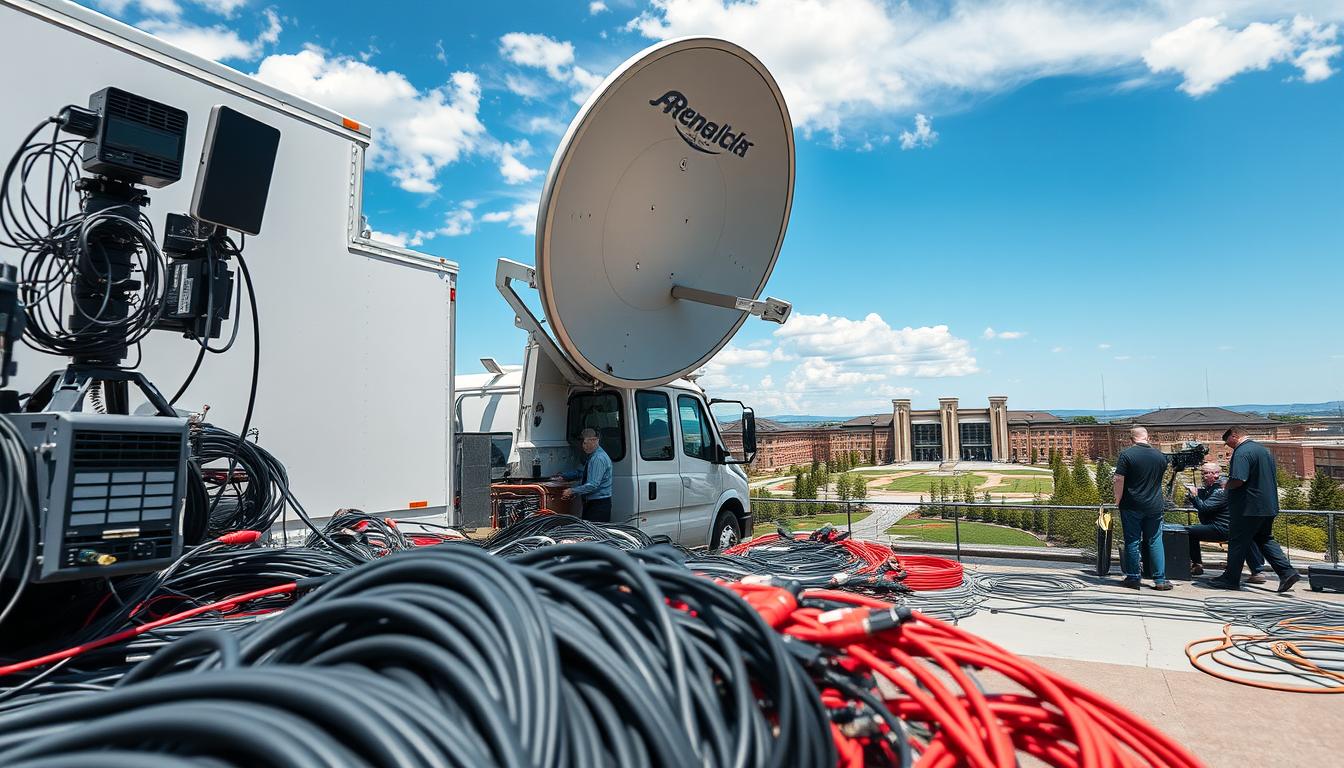
At the heart of this operation are the satellite and production trucks. These are mobile television studios on wheels. For a Big Ten-bound USC, the technical specifications just got a major upgrade.
The broadcast truck is the central hub. It houses the director, producer, and a wall of monitors showing every camera angle. The signal’s journey is a marvel of modern engineering.
It starts with a camera, travels down miles of fiber optic cable, and then into the truck for processing. From there, it goes to the network’s master control via a dedicated fiber path or a satellite uplink. This College Realignment Feature isn’t just about new rivals; it’s about building a fiber and satellite superhighway from the Pacific to the Midwest.
The infrastructure is a web of redundancy. Primary and backup fiber lines, often run through separate underground conduits, ensure the show goes on. The comms room is the nerve center of this web, a soundproofed sanctuary where a producer barks orders to a dozen camera operators, graphics operators, and replay technicians.
It’s a high-pressure cockpit where every second of delay is an eternity. The “comms room” for on-field audio is a logistical ballet of its own. It involves dozens of wireless microphones and IFBs feeding into the ears of commentators and coaches alike.
This complex dance is complicated by the NIL/practice loads that today’s athletes manage. A player’s NIL deal might require a specific sideline shot for a sponsor, or a practice load might dictate a player’s availability for a mid-game interview. The broadcast team must be agile, integrating these new elements into the traditional production script.
The move to the Big Ten amplifies this complexity. It requires coordination with a new conference’s broadcast standards and a much larger geographic footprint for signal distribution.
| Broadcast Element | Old Pac-12 Setup | Big Ten Requirements | Logistical Challenge |
|---|---|---|---|
| Primary Fiber Path | Regional provider, single line | Dual, diverse-path fiber to Chicago | Coordinating with new telecom vendors across 3 time zones |
| Production Trucks | 1-2 trucks for regional broadcast | 3-4 trucks for national, 4K HDR broadcast | Coordinating a cross-country trucking schedule |
| Comms & IFB Channels | Standard 2-4 channels | 6-8 channels for national broadcast team | Integrating new talent, managing more on-air mics |
| Power Redundancy | Single backup generator | Dual, independent power grids | Ensuring uptime for 4+ hour broadcasts |
This isn’t just about adding more cameras. It’s about integrating with the Big Ten Network’s infrastructure. This demands a specific, high-bandwidth feed. The fiber paths that once ran to a Pac-12 Network hub in San Francisco must now be re-routed or duplicated to feed the Big Ten Network’s operations center.
It’s a physical and digital rerouting of the entire signal highway. The NIL/practice loads for athletes also factor in. A star player with a major NIL deal might have a camera dedicated to him for sideline reactions, adding another layer of complexity for the production crew.
So, when you’re watching a nail-biter between USC and Ohio State, remember the hidden game. While you’re watching the quarterback, a small army of technicians is performing a high-stakes, high-tech ballet in a village of trucks. They ensure that every spiral, tackle, and touchdown is captured and beamed across the continent without a flicker.
Ingress/egress & security for a sellout
Forget the game-winning touchdown; the first major play of the day is moving two massive fanbases into and out of the coliseum. This isn’t just traffic control; it’s a real-time, large-scale behavioral science experiment. For the visiting USC or UCLA fan on a Big Ten travel schedule, this isn’t a home game—it’s a logistical expedition requiring a master sleep strategy as critical as the playbook.
Ingress is a phased, multi-layered operation. It begins hours before kickoff, with staggered arrival times communicated through team apps and social media to prevent a tidal wave at the gates. Security has evolved from a simple bag check into a multi-faceted screening process. Metal detectors, bag scanners, and behavioral observation teams work in concert. For the visiting team’s contingent, this process is a gauntlet of unfamiliarity—different entry gates, unfamiliar parking, and a sea of opposing colors. The Big Ten travel experience, therefor, starts with a sleep strategy that accounts for time zone changes and pre-game anxiety, ensuring fans are alert and oriented upon arrival.
The unsung hero of any successful game day is the egress plan. A sellout crowd all leaving at once is a recipe for gridlock. Modern stadiums and traffic planners use a strategy called “staggered egress.” This involves directing different sections to leave at slightly different times via specific, color-coded routes. For the away fan, this means knowing your exit route and having a post-game rally point is part of the sleep strategy. A tired, disoriented fan is a lost fan. The Big Ten travel fan’s post-game sleep strategy might involve a nearby hotel, not a long drive, stressing that the game is just one part of the travel equation.
The table below highlights the different logistical realities for the traveling and local fan.
| Logistical Challenge | The Big Ten Traveler | The Home Team Fan |
|---|---|---|
| Pre-Game Arrival | Requires detailed Big Ten travel plan: flight, hotel near stadium, pre-paid parking pass. Focus on acclimatization and a pre-game nap as part of a sleep strategy. | Relies on local knowledge: backroad routes, unofficial parking, and family/friend drop-off points. |
| Ingress Strategy | Must locate designated visitor gate, often the farthest from parking. Security lines are a calculated risk in the schedule. | Uses well-known shortcuts and preferred gates based on seat location and season ticket holder status. |
| Sleep & Acclimatization | Sleep strategy is key: arriving 2 days early to adjust to time zone, using blackout curtains and melatonin to reset the internal clock for a night game. | Sleeps in own bed, maintains routine. The only sleep strategy is not to over-indulge tailgating. |
| Post-Game Egress | Planned in advance: pre-arranged rideshare, shuttle, or a long, patient walk to avoid gridlock. Part of the Big Ten travel playbook. | Knows the secret exit, the side street to avoid the main artery, or the best post-game bar to wait out the traffic. |
Ultimately, the ballet of ingress and egress is a silent, city-scale operation. Its success isn’t measured in yards gained, but in the absence of chaos. For the visiting fan, a smart sleep strategy and a solid Big Ten travel plan are as vital as a game ticket. The most successful fans aren’t just cheering for their team; they’re executing a meticulously planned logistical operation, where a smart sleep strategy is the unsung pre-game ritual that makes the 4th-quarter victory—or the graceful exit—possible.
Warmups, halftime staging, band routes
Forget the three-act play. College football Saturdays start hours before kickoff. The real drama unfolds in a 20-minute intermission. USC and UCLA’s move to the Big Ten changes game day logistics.
The warm-ups, halftime shows, and band movements are more than traditions. They are a precise logistical ballet. The Midwest’s cold adds a new challenge to the equation.
The 20 minutes before kickoff are filled with controlled chaos. The field is shared by warm-ups, drills, officials, and media. The NIL/practice loads conversation adds complexity. A star quarterback’s pre-game routine is as choreographed as the first play.
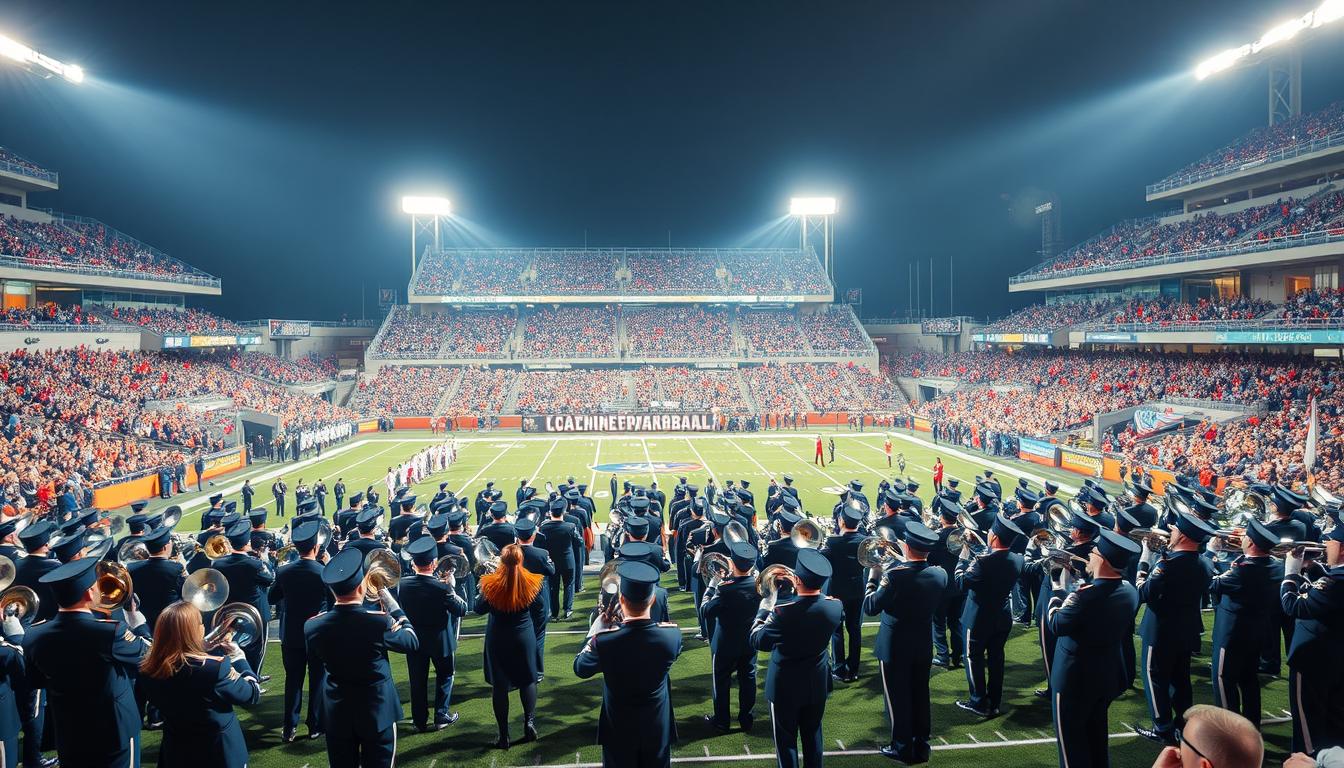
Halftime is a high-stakes, 20-minute logistical miracle. The marching band must execute a flawless, rapid deployment. Bands from warmer climates face challenges in the Midwest’s cold.
The halftime operation is a marvel of precision. Consider the sequence:
- Stage 1 (Halftime Clock 00:00-02:00): Players clear the field as the band assembles. Equipment crews perform a two-minute field check.
- Stage 2 (02:00-05:00): The band takes the field, moving in a single unit. A misstep ruins the formation.
- Stage 3 (05:00-18:00): The performance. Every 8-count is a movement, every turn a calculated risk.
- Stage 4 (18:00-20:00): The egress. The band must clear the field with military precision to avoid penalties.
Directors and drum majors face challenges beyond music. They must consider physics and meteorology. They are field generals, adapting to new variables.
In-game: replay ops, booth ↔ truck coordination
Fans watch the game on the field, but the real excitement is in a dim truck outside the stadium. This is where split-second decisions on coach’s challenges and scoring reviews are made. For USC and UCLA, joining the Big Ten means learning new rules and protocols.
This isn’t just about watching a screen. It’s a high-wire act of technology and human judgment. Every camera angle is scrutinized, every frame analyzed by a crew that now has to coordinate across new time zones and with a conference whose protocols might as well be written in a foreign language. The replay official in the booth isn’t just looking for a toe on the sideline; they’re interpreting a new set of conference-specific rules, often under the immense pressure of a coach’s challenge. The coordination between the on-field officials, the booth, and the replay truck becomes a high-stakes poker game, where the right call can swing a game and a season.
The shift in Big Ten travel and the associated NIL/practice loads on players also subtly changes the replay calculus. Teams traveling longer distances and dealing with more physical, conference-play styles may see more injury stoppages or player safety reviews, putting the replay team on high alert for specific types of calls. The table below highlights the seismic shift in replay operations for the West Coast teams:
| Aspect | Pac-12 Operations | Big Ten Protocols |
|---|---|---|
| Tech Stack & Review Time | Familiar, conference-specific systems with established, often faster, review protocols. | New, often proprietary, conference-mandated systems with potentially different review time allowances. |
| Booth-to-Truck Comms | Established, often informal, communication chains with known officials. | New communication chains with unfamiliar officials and a more centralized, conference-run replay command center. |
| Challenge & Review Triggers | Coaches familiar with Pac-12 officials’ tendencies and replay triggers. | New officiating crews with different “bang-bang play” thresholds and points of emphasis for the Big Ten. |
| Conference-Specific Rules | Pac-12 specific in-game and replay protocols. | Adherence to Big Ten-specific rules on targeting, fumble recoveries, and goal-line stands. |
The replay booth is less a technology hub and more a theater of human judgment. The officials in that truck, now interpreting a new conference’s rulebook under the glare of a national broadcast, hold immense power. For USC and UCLA, every review is now a test of their new conference’s unwritten rules. The “college realignment feature” isn’t just a schedule quirk; it’s a high-stakes crash course in a new football culture, where a single replay can define a season.
Sustainability/community programs on event day
Game day is more than just the game; it’s a big operation focused on zero waste and community. USC and UCLA, moving to the Big Ten, see it as a chance to make a difference. They aim to win games and hearts, while also reducing their environmental impact.
This new approach makes game day a showcase of sustainability and community involvement. Every part of the fan experience is a chance to make a positive impact.
The most visible efforts are in the fan experience:
- Zero-Waste Stadiums: They aim to recycle over 90% of waste. This turns packaging into a loop.
- Community Touchdowns: Food not eaten is donated to food banks. Local groups also run stands to raise money.
- Green Infrastructure: They use solar panels and reclaimed water, making everything more efficient.
For USC and UCLA, this move is a strategic chance. They aim to build a greener legacy in the Big Ten. It shows that being “green” is more than just school spirit.
| Initiative | USC’s Trojan Game Plan | UCLA’s Bruin Blueprint |
|---|---|---|
| Zero-Waste Goal | Divert 90% of Coliseum waste by 2025 with special bins and volunteers. | Make game days carbon-neutral by 2026 with solar and EV stations. |
| Community Touch | “Trojan for a Day” gives local youth sideline access and STEM workshops. | “Westwood to the World” offers mentorship and game tickets to local students. |
| Legacy Building | Planting trees in L.A. and offsetting team travel emissions. | Investing in urban farms near the Rose Bowl for concession produce. |
This isn’t just PR; it’s a key part of their long-term plan. It connects fans who value purpose and sustainability. For USC and UCLA, winning means success on and off the field, leaving a lasting positive impact.
Fan tips: transit, shade, food, photo spots
The realignment isn’t just a map shift; it’s a call to adventure. Your Big Ten travel now spans time zones, not just state lines. Forget the old routes. Your new sleep strategy is as important as the team’s.
It’s not just about the hotel—it’s about arriving at the stadium with your energy, your team’s secret weapon, fully charged.
Your sleep strategy is the first play of the weekend. Red-eyes and long drives are the new norm. Find the hotel with the blackout curtains, book the airport hotel with the 4 a.m. shuttle.
Your recovery, your focus, is what gets you to kickoff with your voice intact.
Once inside the new cathedral, the game begins. Your NIL/practice loads—your investment of time, travel, and voice—mirror the team’s own preparation. Find your shade under the upper deck’s lip, or follow the locals to the concession stand with the secret, unadvertised burger that’s worth the second-quarter line.
The photo op isn’t just a selfie; it’s a historical marker. Capture the scoreboard at the moment the new era became real.
This is the new calculus. Your travel, your stamina, your strategic hot dog purchase—they’re all part of the team’s NIL/practice loads. Your energy in the stands is the other half of the team’s practice-field sweat.
You’re not just witnessing the new Big Ten. You’re conditioning for it.