Rob Larson has moved from promising Folsom varsity target to one of the most watched wide receivers in Northern California high school football. As of August 20, 2026, the Folsom High School Class of 2027 receiver is already committed to UCLA, has a major junior-season stat line behind him, and carries the kind of local profile that makes Friday-night defenses adjust before the first snap.
Why Rob Larson Stands Out In NorCal
Rob Larson By The Numbers
Larson is listed at 6-foot-2 and 200 pounds, a frame that fits the modern outside receiver mold and gives Folsom a target with size on the perimeter. Yahoo Sports listed him at those measurements while reporting his UCLA commitment and his earlier varsity production Yahoo Sports report. That size matters in the Sierra Foothill League setting, where physical defensive backs and fast pursuit angles can close space quickly.
The measurable traits are only part of the picture. His Hudl profile lists a 4.56-second 40-yard dash and a 352-pound squat. Those numbers point to an athlete with straight-line speed and lower-body strength, both valuable for a receiver asked to separate, absorb contact, and finish plays after the catch. The speed figure helps explain why Folsom could use him as more than a possession option, while the strength measure helps frame his ability to play through contact.
From First Varsity Year To Breakout
His jump from sophomore to junior production was the clearest sign of his rise. In 2024, his first varsity campaign, Larson had 23 catches for 503 yards and five touchdowns. In 2025, during Folsom’s 14-1 season, he produced 82 receptions, 1,146 receiving yards, and 18 touchdowns. That kind of year-over-year shift says plenty about trust, usage, and consistency inside a high-level high school offense.
Folsom football has long drawn attention around Northern California because the Bulldogs often pair quarterback play with receiver development. Larson’s 2025 season fit that identity without needing any extra decoration. An 82-catch season requires weekly involvement, not just isolated explosive plays. The touchdown total also shows that he was part of scoring situations, not only a yardage piece between the 20s. For opponents across the region, that forces a practical question: how much coverage help can a defense send his way without giving Folsom other answers?
The Production Behind The Rise
Big Games Against Local Powers
The 2025 game logs in the research show why Larson’s name traveled beyond Folsom. He had 170 receiving yards against Grant on August 23, 2025. One week later, on August 30, 2025, he recorded 105 yards against Junipero Serra. On September 19, 2025, he posted 119 yards and one touchdown at Rocklin. Those three dates placed his production against programs that draw attention in Northern California and the broader state conversation.
That stretch also helps separate steady production from empty volume. A receiver can stack numbers in a pass-heavy system, but producing against strong opponents gives those numbers better context. Folsom’s 14-1 record in 2025 adds another layer: Larson’s output came inside a winning team structure, not as the main statistical bright spot on a struggling roster. That makes Rob Larson a strong example of how team success and individual development can rise together when a staff identifies a reliable matchup advantage.
Recognition Across The Sacramento Area
Regional recognition followed. Larson was selected First Team All-Metro by The Sacramento Bee in 2025 as a junior and was listed at wide receiver while representing Folsom. That honor matters locally because Sacramento-area football has enough depth that standout seasons can be crowded. To be named at receiver in that group means coaches, media observers, and opponents had enough evidence across the fall to place him among the area’s best.
For Folsom, the recognition also reinforces the program’s place in the local player-development chain. Youth players in the area see the path: earn varsity snaps, produce in league and nonleague games, gain regional notice, and attract college attention. Not every athlete follows that same pace, but Larson’s timeline gives families and younger receivers a clear example of what production can look like at a program with high expectations.
Recruiting Value And UCLA Fit
Commitment Timeline
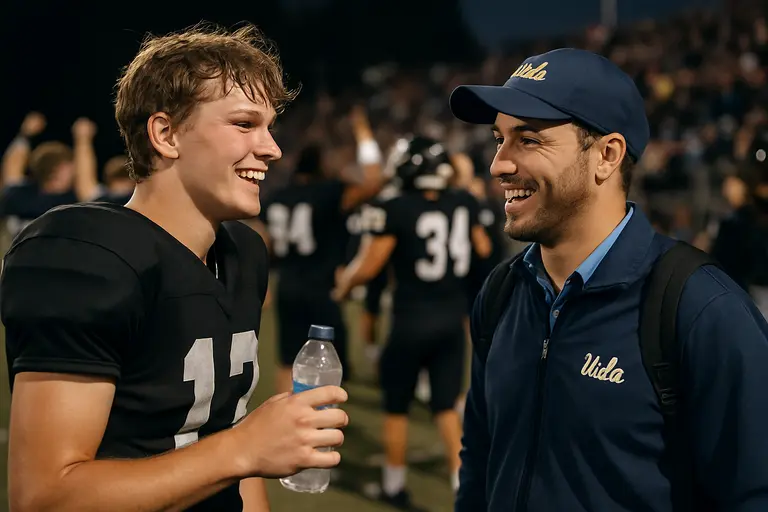
On May 3, 2026, Larson committed to UCLA to continue his football career at the college level. The decision connected one of Sacramento-area football’s rising receivers with a Big Ten program that recruits California heavily. For a Folsom athlete, staying in-state for college football also keeps his story close enough for local coaches, teammates, and younger players to follow without losing the Northern California tie.
Recruiting attention can change the weekly conversation around a high school player, but the verified pieces of Larson’s profile are straightforward: size, production, speed, strength, recognition, and a Power Five commitment. ESPN lists him as a wide receiver with a scout grade of 76 and shows a recruiting profile that includes college interest ESPN recruiting profile. That outside evaluation gives his local production a national recruiting reference point.
Scouting Grade Context
A scout grade is not a career prediction by itself. It is better used as a snapshot of how a prospect is viewed at a given stage. In Larson’s case, the grade sits alongside a strong 2025 season and a commitment made before his final high school year had been recorded in the provided research. That timing matters because college staffs often value players who have already shown both physical traits and repeatable game production before the final recruiting cycle tightens.
From a football standpoint, his profile gives UCLA a receiver with verified high school volume and size. From a local standpoint, it gives Folsom another recruit tied to a visible college program. The recruiting story is not just about a logo or offer list; it is about how Northern California receivers continue to earn attention through Friday-night production, regional competition, and development within proven high school systems.
What Rob Larson Means For Folsom Football
Folsom’s Local Receiver Identity
For Folsom families, Rob Larson represents more than one stat line. His rise fits a community where high school football carries real week-to-week weight, from campus energy to local youth interest. A player with his production gives the Bulldogs a visible standard at the receiver position: run, catch, block, finish, and repeat it against quality opponents. That is the kind of example that can shape offseason workouts and positional expectations for younger players.
The most useful read on his profile is not to crown him beyond what the verified record supports. The record already says enough. He is a 6-foot-2, 200-pound Class of 2027 receiver from Folsom. He moved from 23 catches as a sophomore to 82 as a junior. He scored 18 touchdowns during a 14-1 Folsom season in 2025. He earned First Team All-Metro recognition. He committed to UCLA on May 3, 2026. Those facts place him among the leading wide receiver stories in Northern California high school sports.
Why The Story Resonates Locally
Folsom’s football community has reason to pay attention because Larson’s development shows how a player can move through the local pipeline with steady gains rather than sudden noise. The sophomore season established varsity footing. The junior year delivered production. The recruiting profile brought college validation. For coaches around the region, that path is a reminder that receiver development is built through timing, strength, route detail, and trust within the offense.
As of August 20, 2026, the next chapter of Larson’s high school career had not been documented in the provided research. What can be said with confidence is that his 2025 season already gave Folsom a receiver season worth remembering and gave Northern California another player to track on the road from local fields to college football.