
USC Football Facilities are becoming a central part of the Trojans’ push to sharpen daily training, strengthen recruiting conversations, and give the football program a clearer home on campus. The Bloom Football Performance Center is not just another building project near the practice field. It is tied directly to how players lift, recover, meet, eat, study film, and prepare for the physical demands of Big Ten football.
USC broke ground on the 160,000-square-foot Bloom Football Performance Center on Nov. 7, 2024, with the project costing more than $200 million and scheduled to open in summer 2026, according to USC’s project announcement. For a Los Angeles program with national recruiting reach and strong local ties, that timeline matters. The roster pieces arriving for the 2026 season, including a highly rated recruiting class in the research notes, could be among the first groups to feel the full effect of the new setup.
How USC Football Facilities Change Daily Training
USC Football Facilities And Player Routine
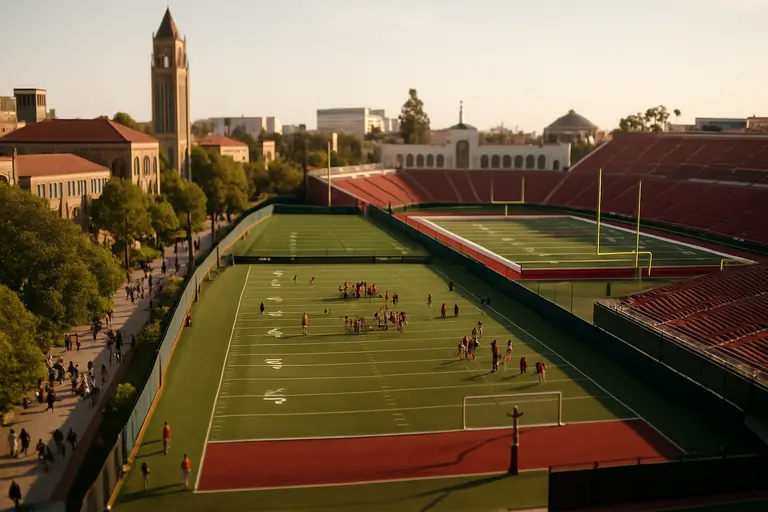
The best football buildings are judged by how they shape ordinary work. USC’s planned center is listed with two full-length outdoor practice fields, a locker room, recovery spaces, nutrition and training areas, a team auditorium, and meeting rooms. Those are not separate conveniences. They are the backbone of a college football week, especially for a roster that must manage classes, position work, strength sessions, film review, recovery, and travel planning.
For players, the value is time and consistency. A quarterback moving from a morning lift to a meeting room, an offensive lineman getting treatment after practice, or a freshman trying to adjust to college football all benefit when the routine is clear. That does not guarantee wins, and it should not be framed that way. Facilities give coaches and athletes a better working environment. The results still depend on player development, health, game plans, and how the roster handles pressure.
Recovery, Nutrition And Meeting Flow
The recovery and nutrition pieces are especially relevant in the Big Ten setting. USC now faces more demanding travel patterns than it did in its former conference setup, and the physical style of league play places a premium on depth. A facility that puts recovery, training, food, and position meetings in the same football hub can help staff keep the week organized. That can be valuable during short turnarounds, heavy academic periods, or stretches when players are managing bumps and workload.
Meeting rooms and a team auditorium also carry football value beyond comfort. Defensive installation, offensive protection calls, special teams details, and scouting reports all depend on clear teaching. A well-planned building can support that teaching by reducing lost time between practice and film. For young players, especially incoming recruits learning college terminology, that daily rhythm can make the jump feel less scattered.
Roster Additions Meet A Bigger Training Plan
Recruiting Class Raises Practice Competition
The research notes list USC’s 2026 recruiting class as No. 1 nationally, with three five-star recruits and 19 four-star recruits. If that class arrives as described, the immediate local angle is competition. Star ratings do not play snaps by themselves, but a deep class can push practice tempo, force younger players to earn roles, and give position coaches more options across the two-deep.
For USC Football Facilities, the timing is important because the Bloom center is scheduled to open in the same general period as that incoming talent begins its college development. A recruit’s first year often includes strength gains, position technique, playbook work, and learning how to handle the week-to-week demands of college football. A new football hub gives USC a platform to support those steps in a more connected way.
Returning Pieces Give Coaches A Starting Point
The roster discussion is not only about newcomers. The research notes also identify quarterback Jayden Maiava and four returning offensive line starters as key returning pieces. That kind of offensive continuity can matter when a staff is trying to blend new talent with players who already know the system, the locker room, and the expectations inside the program.
On defense, the notes point to Gary Patterson as a defensive coordinator addition aimed at strengthening that side of the ball. Patterson’s arrival, paired with added recruits and returning players, puts attention on teaching and alignment. A new practice environment cannot make tackles or cover routes, but it can give coaches more structure for installation, corrections, and position-specific work. That is where facilities and roster planning overlap.
Campus Design With A Football Purpose
Fields, Lockers And Staff Workflow
The design side of USC Football Facilities is being led by HNTB, which describes the project as focused on operational functionality and the player experience through the Bloom Football Performance Center. That phrase matters because a football building has to serve several groups at once: athletes, coaches, trainers, nutrition staff, equipment staff, recruiting staff, and operations personnel.
- Two full-length outdoor practice fields to support on-field work.
- Locker room space for daily team use and game-week preparation.
- Recovery, nutrition, and training areas connected to player care.
- A team auditorium and meeting rooms for instruction and film review.
Those pieces are common in major college football, but the arrangement is what shapes daily use. If players can move from field work to recovery and then into film without long gaps, the building supports the schedule rather than simply housing it. For staff, that can help with communication across departments. For recruits, it shows how the program expects players to spend their days once the official visit is over.
Athletics West And Local Space
The Bloom project is also tied in the research notes to USC’s Athletics West initiative, which is intended to improve athletic facilities and use campus space more effectively. That local campus piece should not be overlooked. USC sits in the middle of Los Angeles, where space is valuable and every major project affects how students, athletes, staff, and visitors move through the area.
For Southern California high school players and families visiting campus, the football center will likely become part of the first impression. The same is true for alumni, donors, and local fans who follow recruiting as closely as Saturday results. A facility cannot replace relationships with high school coaches or the trust built during recruitment, but it can support the message that USC is investing in the full football operation.
Why USC Football Facilities Matter To Los Angeles Prep
Recruiting Visits And Family Impressions
Los Angeles football has always been tied to neighborhoods, high school programs, family networks, and weekend travel across the region. USC’s recruiting reach is national, but the local pipeline remains a major part of the program’s identity. A new performance center gives the Trojans a clearer story to tell recruits from nearby schools: this is where you will practice, train, recover, meet, and build your college routine.
That pitch still has to be backed by coaching, playing time, academic fit, and personal trust. Families are not only looking at weight rooms and practice fields. They are asking how a program will support a young athlete through injuries, depth-chart competition, academic pressure, and life away from home. The Bloom center can answer part of that question by showing the resources available in one football-focused setting.
What Should Be Measured Next
The fair way to judge this investment is not through instant claims. Once the center opens, the meaningful signs will be practical: how quickly young players develop, whether roster depth improves, how staff use the building during heavy travel weeks, and how recruits respond after seeing the space in person. Those are football measures, not ribbon-cutting talking points.
USC Football Facilities are now part of a larger Trojans story that includes roster additions, returning offensive experience, a defensive staff change, and a major campus investment. For local fans, the project is worth tracking because it connects the future of USC football to the everyday work that happens before kickoff. The Bloom center will not decide the season by itself, but it gives the program a new foundation for the training, teaching, and recruiting work that shapes Saturdays in the Coliseum.