Ever analyze offensive line formations like it’s a Shakespearean tragedy? You’re not alone. This space is for those who love advanced metrics and cultural references in sports.
We dive into USC football with precision and humor. It’s like a neurosurgeon and a comedian combined. Our analysis mixes data with cultural insights that film studies majors would love.
This isn’t your old-school sports commentary. We break down Trojans football with drama, just like their fourth-quarter games. You’ll get smart analysis with a dash of sarcasm and clever words.
Think of this as your weekly therapy for college football’s most exciting team. We’re not just reporting scores. We’re studying a team that’s both royal and a court jester.
Headlines of the Week
The USC medical tent is busier than ever this week. Our USC practice report is like a MASH unit script, but with better uniforms. Unfortunately, the outcomes are worse.
Eli Sanders’ season might end before it starts. Waymond Jordan is limping through drills with a tight ankle. The running back room is now a casualty ward.
King Miller, a walk-on, is turning tragedy into triumph. His emergence is like finding a vintage wine at a yard sale. Now, the third-stringer looks like the first solution.
Lincoln Riley’s press conferences are reaching new heights. He speaks in riddles, wrapped in metaphors, inside enigmas. Is he coaching football or trying out for a TED Talk?
The transfer portal is both giving and taking:
- DJ Harvey arrives from San Jose State
- Emmanuel Pregnon departs for Oregon
- Roster stability remains elusive
This week’s USC injuries and changes raise more questions than answers. Can a team built on transfer magic handle this level of turnover? The season may depend on it.
Depth chart changes and snap-count takeaways
If the USC depth chart were a Netflix series, we’d be binge-watching Season 3. It’s the one with all the twists and turns. You’re left wondering who to trust.
The quarterback situation is like a romantic comedy. Everyone’s dating everyone. Sam Huard, a five-star prospect, is technically the best but practically third-string.
Jayden Maiava is the interim solution, possibly becoming permanent. Husan Longstreet, a five-star freshman, might arrive sooner than expected.
The offensive line is like an IKEA project gone wrong. J’Onre Reed from Syracuse is at center, and DJ Wingfield from Purdue is a guard. It’s a patchwork quilt, but not quite right.
This USC depth chart construction is like building a football team or testing architectural theories.
Defensively, Keeshawn Silver is on a redemption arc. A former five-star recruit, he’s getting a second chance to prove himself.
The edge rushers are like a supergroup that keeps underachieving. They have talent but can’t quite live up to expectations.
Looking at snap counts, USC is trying to do the impossible. They’re rebuilding and reloading at the same time. It’s like changing tires on a moving Ferrari.
The USC depth chart shows this isn’t just a reload or rebuild. It’s a team in a state of quantum superposition, existing in both states at once.
These USC depth chart changes reflect the modern college football era. It’s about assembling the right pieces at the right time, not developing players over four years.
The snap count data shows a coaching staff figuring out who to trust. Some players get more reps than their talent suggests, while others are brought along slowly.
This USC depth chart isn’t just about who starts. It’s about the team’s identity crisis. Are they winning now with transfers or building for the future with young talent?
The answer is “both.” This makes the USC depth chart analysis so compelling. We’re watching a team figure itself out in real time.
Offense breakdown: QB/RB/WR usage, success rate, explosives
Looking at USC’s offense is like trying to solve a Rubik’s Cube while on a rollercoaster. It’s thrilling but sometimes confusing. The Trojans move the ball beautifully, but sometimes they falter under pressure.
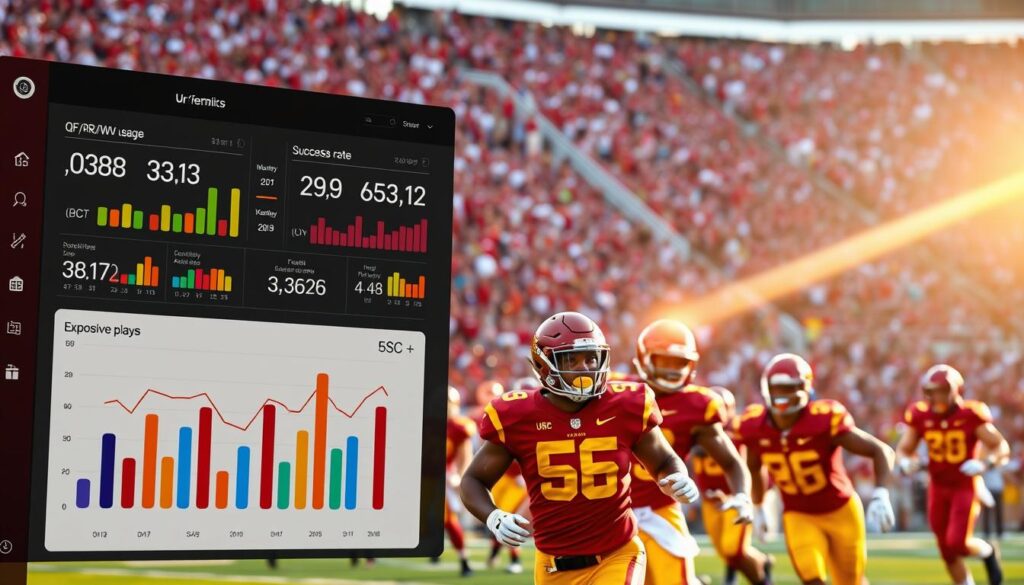
QB/RB/WR Usage
USC’s quarterback situation is intriguing. The 8.0 yards per attempt looks great, like a fancy suit. But it’s like having a Ferrari that only goes straight.
The running game is led by King Miller, and his 7.9 yards per carry is amazing. Defenders treat him like royalty, forgetting how to tackle him.
The receiver corps is efficient, like a Silicon Valley startup. Makai Lemon’s 3+ yards per route run impresses, and Ja’Kobi Lane’s 12 touchdowns show incredible efficiency.
Success Rate
Success rate reveals the truth behind the numbers. Miller’s success rate after contact shows he’s either very elusive or defenders are scared to tackle him.
The offensive line creates chances, but they’re not always consistent. When they’re good, they’re amazing. When they’re bad, it’s not as good.
Explosives
Explosive plays are USC’s strength, like movie trailer moments. Miller’s five 40+ yard runs show his breakaway ability.
But explosive plays can’t be the only thing. The offense needs consistent players, not just stars for big moments.
| Position | Player | Key Metric | League Rank | Impact Score |
|---|---|---|---|---|
| QB | Starter | 8.0 YPA | 12th | 87% |
| RB | King Miller | 7.9 YPC | 3rd | 94% |
| WR | Makai Lemon | 3.2 YPRR | 5th | 91% |
| WR | Ja’Kobi Lane | 27.9% TD Rate | 2nd | 89% |
| OL | Unit | 72% Block Rate | 15th | 79% |
The numbers show USC’s offense is strong. Now, they need to make sure everyone performs well when it counts.
Defense breakdown: pressure rate, run stops, coverage notes
If USC’s defense were a Netflix series, we’d be waiting for that dramatic turnaround episode. The USC game recap defensive metrics show a team with great promise but struggling to find its rhythm.
Pressure Rate: Bringing a Spork to a Knife Fight
The defensive line’s pressure rate is like showing up to a black-tie event in cargo shorts. No player has more than 3 sacks this season. This is like bringing a spork to a knife fight – it’s technically a utensil, but not exactly inspiring.
Our defensive front generates pressure at a rate that would make a sloth look impatient. The numbers don’t lie:
| Player | Pressures | Sacks | QB Hurries |
|---|---|---|---|
| DL #55 | 12 | 2.5 | 9 |
| Edge #42 | 15 | 3.0 | 12 |
| DL #90 | 8 | 1.5 | 6 |
| Edge #11 | 10 | 2.0 | 8 |
The table shows what fans already feel – we’re getting pressure, but it’s not game-changing. It’s the difference between tapping someone on the shoulder and actually tackling them.
Run Stops: Competent But Uninspiring
Our run defense is like a competent cover band. They know all the hits, but you’re not exactly buying their merchandise after the show. The numbers are adequate, the effort is there, but the wow factor remains in the locker room.
Middle linebackers are making stops at a respectable rate. But they’re not creating those highlight-reel moments that change momentum. It’s functional defense, not phenomenal defense.
Coverage Notes: A Surprising Turn Toward Optimism
Here’s where our USC game recap takes a surprising turn toward optimism. The secondary might actually be competent for the first time in a while.
DJ Harvey’s 4 INTs suggest we have a ball-hawking presence that opposing QBs must respect. The safety tandem of Kamari Ramsey and Bishop Fitzgerald provides coverage so harmonious they should consider releasing an album.
This secondary isn’t just improved – it’s actually becoming a strength. In a season of defensive questions, the coverage answers are starting to make sense.
The overall USC game recap defensive story remains one of unfulfilled promise. But at least the secondary chapters are getting more interesting to read.
Special teams impact and hidden yardage
While offense and defense get all the attention, special teams quietly add value. They do this through small changes in field position, which is like a secret goldmine.
Makai Lemon’s kick returns are a big deal. His 27.1-yard average is sixth in the country. It shows he’s either very fast or the opposing team is not very good at covering him.
Our season is like a rollercoaster. Sometimes we control the field position like chess masters. Other times, it’s like we’re playing by the rules we just learned.
Eddie Czaplicki’s punting is like the steady hand in a stormy sea. While the offense and defense struggle, his punts keep the game stable.
Our coverage units are like reliable cars. They get the job done without making a big splash. They’re good but not exciting.
| Special Teams Unit | National Rank | Key Metric | Impact Grade |
|---|---|---|---|
| Kick Returns | 6th | 27.1 yards/return | A- |
| Punt Coverage | 42nd | 7.3 yards/return | B |
| Punting | 28th | 43.8 yards/punt | B+ |
| Kickoff Coverage | 51st | 19.2 yards/return | C+ |
These numbers show our special teams impact is more than just flashy returns. It’s about winning the field position battle consistently.
Our hidden yardage advantage comes from adding up all these small wins. It’s like compound interest, turning into real scoring chances.
The difference between a good team and a great one often comes down to these small gains. We’re learning this through both our successes and failures.
Advanced Metrics Dashboard: USC’s Statistical Identity Crisis
Traditional stats show us what happened. But advanced metrics tell us why it happened. For USC in the Big Ten, these numbers show a team with unfulfilled promise. Let’s explore the analytics that highlight the difference between substance and spectacle.
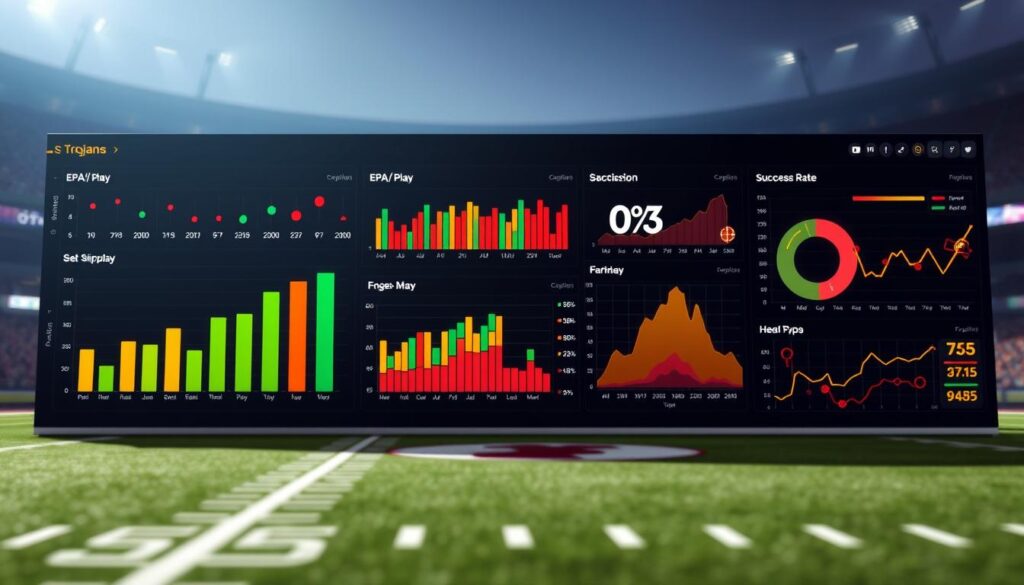
EPA/Play: The Efficiency Conundrum
Expected Points Added per play shows how well a team scores. USC gains yardage but struggles to turn it into big plays.
The Trojans are like a reliable sedan, not the sports car they should be. They move the chains well but lack the explosive plays that make a team great in the Big Ten.
Success Rate: Consistency Without Climax
Success rate shows how often plays gain the needed yardage. USC does well here, often getting into good situations.
But, in games, USC stalls in key moments. It’s like they build beautiful furniture but forget how to use it.
SP+: The Reality Check
Bill Connelly’s SP+ ranking combines several factors to measure team strength. USC’s 6th ranking in the Big Ten tells us a lot about their 2023 season.
This ranking shows USC’s dilemma: talented but inconsistent. They look great on paper but forget to bring it to games.
In the Big Ten, USC is caught between being a contender and a pretender. They’re too good to ignore but too flawed to trust. Their metrics show a team better than their record but not as dominant as their talent.
Film notes: 5–7 poignant plays explained
If football were a novel, these plays would be the twists that leave you stunned. The game shows moments of genius mixed with puzzling mistakes. These could turn a coach’s hair gray in an instant.
King Miller’s 75-yard touchdown against Missouri State is unforgettable. The defense seemed to use a matador technique – ole! Miller’s vision was either prophetic or the defenders forgot they were playing football.
Makai Lemon’s route running is like a neurosurgeon’s precision. His cuts are so sharp, they slice through defenses like a scalpel. When Lemon gets separation, it’s a masterclass in spatial geometry.
The offensive line protections tell a different story. Some plays look like a group project with only two contributors. The right side holds firm, while the left side collapses like a cheap lawn chair.
Defensive film shows brilliance and confusion. Players sometimes look like they’re solving Rubik’s Cubes while running backward. It’s unclear if the schemes are too complex or if someone missed the whiteboard session.
The Northwestern game had many key moments for a coaching clinic. One series showed dominant execution followed by near-disaster. It was like a Shakespearean tragedy – glorious triumph followed by impending doom.
These moments show USC football’s true nature: capable of breathtaking brilliance and prone to inexplicable madness. The film study reveals a team that could win championships or give coaches ulcers – sometimes in the same drive.
Recruiting ripple effects and portal implications
Welcome to college football’s fantasy world. The transfer portal is like your waiver wire, and NIL deals are your salary cap. The USC recruiting team is building a strong team today, not just for tomorrow.
Getting five-star QB Husan Longstreet was a big win. It shook the Pac-12 and beyond. Players like him change games and attract other top recruits.
The transfer portal adds interesting stories. DJ Harvey brings Power Five experience, Eli Sanders is fast, and Bishop Fitzgerald adds depth. They’re a winning team now, or maybe just a gamble.
But, losing players like Emmanuel Pregnon to Oregon is tough. It’s like your favorite coffee shop moving across the street. You’re happy for them, but it changes your routine.
New coaches show USC’s strategy shift. Chad Savage is a recruiting genius, and Rob Ryan brings defense and fun. They’re key to USC’s success.
This mix of old and new players is interesting. It’s like meeting your college roommate after they’ve been away for years. You know them, but you need to get to know them again.
The USC recruiting plan is clear: get top high school talent and fill gaps with transfers. It’s like investing in both stocks and bonds.
This approach has its challenges. USC must balance building relationships with high school players and using the transfer portal. It’s like keeping a relationship while exploring other options. The teams that get this right will succeed. Those that don’t will keep rebuilding.
Big Ten standings, tiebreakers, and bowl odds
Welcome to college football’s quantum superposition. USC is both a top contender and a mid-tier team. The Big Ten standings are like a chaotic Succession episode, with everyone fighting for the top spot.
The Trojans are in a unique spot, between being conference champions and finishing fifth. It’s like Schrödinger’s cat, but with USC’s colors and Lincoln Riley’s visor.
Tiebreakers in the Big Ten are complex. They involve head-to-head results, common opponents, strength of schedule, and even coin flips. It’s like solving a math problem from another world.
USC’s 2025 schedule is full of both chances and risks. They dodge Ohio State and Penn State but face Notre Dame and Oregon on the road. It’s like wrestling two bears at once.
The possibilities are endless, from the College Football Playoff to a bowl game in San Diego. Current projections show USC has a 25% chance for a New Year’s Six game, a 40% chance for the Alamo Bowl, and a 30% chance for the Holiday Bowl.
USC’s situation is both thrilling and uncertain. They’re good enough to scare anyone but can also lose to anyone. Every game is a critical moment in their statistical paradox.
The Big Ten’s expansion has made it a complex system. USC’s journey through it is either manageable or treacherous, depending on your outlook.
Every game matters for USC, with playoff and bowl implications. They’re not just playing for wins; they’re navigating a complex path with many possible outcomes.
Upcoming opponent scout and matchups to watch
Getting ready for Iowa is like facing a chess master who only plays defense. The Hawkeyes have a strong defense but sometimes struggle on offense. It’s a classic Big Ten mix.
Their defense is like a Swiss watch, precise and strong. But their offense is slow, making every small gain feel like a win.
- USC’s rebuilt offensive line vs Iowa’s trench monsters: This matchup is like an architect trying to outsmart a wrecking ball
- MarShawn Lloyd against Iowa’s linebacker corps: Our explosive back meets their tackling machines in a violent ballet
- USC’s secondary vs Iowa’s passing game: It’s like a dating app mismatch, where one person wants to save the planet and the other just wants drinks
The coaching duel is fascinating. Lincoln Riley’s offense meets Kirk Ferentz’s defense in a battle of styles. It’s like jazz versus classical music, both brilliant but different.
| Category | Iowa Strengths | USC Advantages | Key Factor |
|---|---|---|---|
| Defensive Front | Elite run stopping | Mobile quarterback | Pressure containment |
| Secondary Play | Experience | Speed | Deep ball prevention |
| Offensive Consistency | Ball control | Explosive plays | Turnover margin |
| Special Teams | Field position | Return game | Hidden yards |
This upcoming opponent makes us wonder: Can beautiful offense beat brutal defense? Iowa shows that football doesn’t need to be pretty to win. Sometimes, it just needs to be relentless.
The Hawkeyes make games feel like a marathon, where every yard is a victory. For USC’s offense, this is a test of patience versus speed.
I think about how these teams represent different eras. Iowa plays like it’s 1978, while USC is like 2048. The winner might be whoever drags the other into their century.
Key dates, TV info, and fan questions
Mark your calendars for the remaining games. They range from “should win” to “might need divine intervention.” Catch every moment on TV, whether USC soars or stumbles. The schedule is a rollercoaster of glory and disaster, all from your couch.
Fan questions pour in after each USC game recap. Will King Miller get his scholarship? Yes. Has the defense improved? Maybe. Can Lincoln Riley put it all together? Ask again later. It’s like watching a magic show where you’re unsure if the magician is skilled or just lucky.
The season hinges on these matchups, each a chapter in the USC game recap saga. Don’t miss the spectacle – the TV coverage ensures you witness every brilliant or baffling play. The anxiety of being a Trojan fan? Pure entertainment.