
Imagine flying across the country just to get demolished on national television. Then spending five hours trapped in a metal tube with your thoughts. That’s the new reality of bicoastal conference life.
When USC quarterback Miller Moss described those post-loss flights as “sucking,” he wasn’t being dramatic. He was capturing the existential dread of cross-timezone competition. The numbers back him up – teams crossing two or more zones went 8-18 last season.
But here’s the million-dollar question: was Oregon’s championship run despite three cross-country trips the exception? Or are we watching mediocre teams use travel as their favorite scapegoat?
Welcome to college sports’ new normal, where the Rose Bowl isn’t just a destination – it’s your weekly commute. This seismic shift in the UCLA Big Ten schedule changes everything for players and spectators alike.
Travel miles, time zones, and recovery logistics
Ever tried waking up after a red-eye flight? Now imagine doing it with 300 pounds of muscle and needing to perform like a pro athlete. Welcome to USC’s new reality in the Big Ten.
The Cross-Country Grind
USC’s travel schedule is a nightmare. They cross three time zones regularly. It’s like asking your body to solve quantum physics while running a marathon.
Sleep experts say this is “dyssynchrony.” Your body’s clock throws a tantrum. This messes with athletic performance.
| Team | Average Travel Miles | Time Zones Crossed | Recovery Time Needed |
|---|---|---|---|
| USC | 2,100+ | 3 | 4-5 days |
| Ohio State | 800 | 1 | 2 days |
| Michigan | 750 | 1 | 2 days |
| Penn State | 950 | 1 | 2-3 days |
Oregon takes a week to acclimate. It’s like NASA’s Mars prep. They teach athletes to be time zone ninjas.
Nebraska’s sports science coordinator, Mitch Cholewinski, tells players to avoid Raising Cane’s before dinner. Chicken fingers are bad for peak performance. Who knew?
Effective fatigue management is key to winning. The USC Big Ten travel experience needs science, not just miles.
Strategic napping, hydration, and meal timing are as vital as playbooks. No coaching can fix jet lag.
TV windows and kickoff tips for West Coast fans
Imagine setting your alarm for what feels like a middle-of-the-night horror movie marathon, only to realize it’s actually game time. Welcome to the new reality of West Coast college football in the Big Ten.
The brutal science of 9 AM kickoffs
Our bodies naturally run on a 24.2-hour circadian rhythm. Traveling east forces athletes to compete against their own biology. It’s like asking a night owl to win a chess tournament at sunrise.
West Coast teams facing early Eastern Time Zone games experience:
- Reduced reaction times comparable to having 0.08% blood alcohol content
- Decreased muscle strength and power output
- Impaired decision-making during critical game moments
The UCLA Big Ten schedule now includes these biological obstacle courses. Players compete while jet-lagged.
Prime time becomes actually prime
Here’s the beautiful twist: 4:30 PM Pacific kickoffs become 7:30 PM Eastern golden hours. West Coast teams suddenly get:
- National exposure to 90 million Eastern Time Zone viewers
- Prime advertising slots previously reserved for SEC matchups
- Recruiting visibility that makes Pac-12 After Dark look like local access TV
The TV windows transform from disadvantage to strategic advantage. Night games become national events.
Survival guide for West Coast viewers
How do you adapt your viewing habits to this new reality? Think of it as learning to appreciate espresso instead of your usual pour-over.
| Time Slot | West Coast Viewing | Strategy | Caffeine Required |
|---|---|---|---|
| Noon Eastern | 9:00 AM Pacific | Pre-game breakfast tacos | 2 cups minimum |
| 3:30 PM Eastern | 12:30 PM Pacific | Lunchtime viewing parties | 1 espresso shot |
| 7:30 PM Eastern | 4:30 PM Pacific | Happy hour kickoffs | Zero – beer time |
| 8:00 PM Eastern | 5:00 PM Pacific | Prime time exposure | Optional cocktail |
The early slots demand adjustment. But the prime time opportunities create unprecedented national exposure. It’s a trade-off between beauty sleep and national relevance.
West Coast fans now experience what East Coast colleagues have long understood: football isn’t just a Saturday afternoon activity. It’s an all-day cultural event that starts with coffee and ends with cocktails.
Scheduling quirks for football, hoops, Olympic sports
Welcome to college sports’ version of Planes, Trains and Automobiles. The scheduling is as unpredictable as the weather. The UCLA Big Ten schedule is a logistical nightmare.
Football’s First-Class Treatment
Football is in its own world. They have charter flights and special recovery plans. Their fatigue management is top-notch, with sleep and nutrition experts.
Their schedule is like a geography professor’s dream. UCLA plays at Rutgers, then home. It’s a 5,000-mile trip in seven days. Teams see more airports than end zones.
Basketball’s Cross-Country Comedy
Mick Cronin’s press conferences are a must-see. He’s a frequent flyer MVP. His teams travel so much, they circle the Earth 1.4 times.
Cronin’s teams face weather delays and changed practice times. The UCLA Big Ten schedule turns basketball into an extreme travel sport.
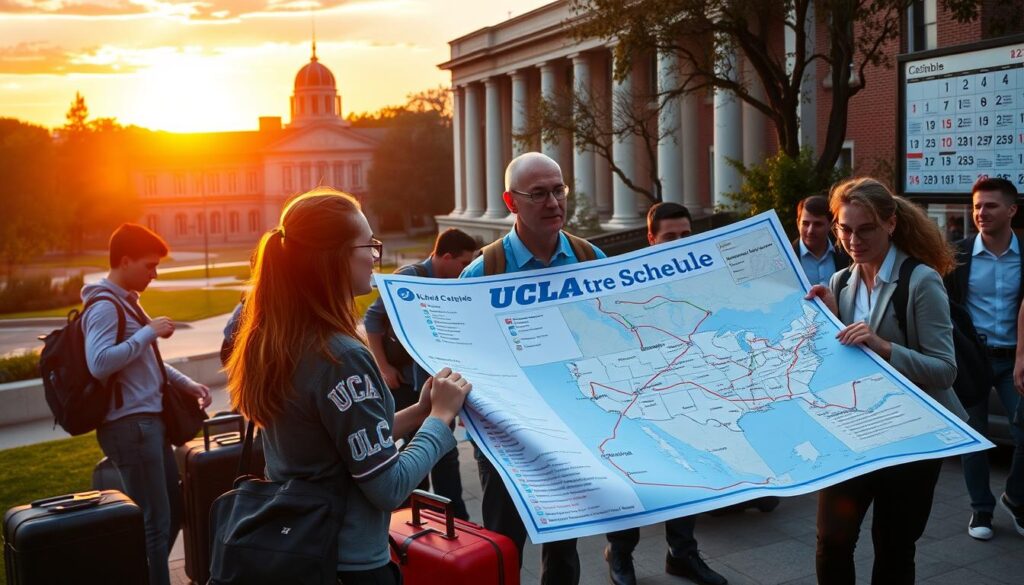
Olympic Sports’ Commercial Travel Roulette
Olympic sports face the real scheduling madness. They travel by commercial flights. They deal with long layovers and lost equipment.
The UCLA women’s soccer team won the Big Ten tournament in Minnesota. They played in the snow. Their fatigue management strategy? Hope the hotel has working heat.
Baseball players have it worst. They play doubleheaders and then wait hours for flights. They arrive at 3 AM for 8 AM classes.
Football gets treated like royalty. Basketball players are frustrated. Olympic sports get what’s left. It’s like Animal Farm—some sports are more equal than others.
Competitive balance and scouting challenges
Let’s get to the truth about competitive balance in the Big Ten. The numbers show it’s more about location than skill.
Last season, Big Ten teams won 47 games at home. This might seem like a clear advantage. But there’s more to it.
The Travel Tax: More Than Just Frequent Flyer Miles
When you look at travel, things get more interesting. Ohio State, Penn State, and Indiana only crossed one time zone. But USC, UCLA, and Washington flew a lot.
These West Coast teams ended up 11-16. It’s not a coincidence. It’s like Seattle’s weather forecast.
Point spreads also tell a story. Teams traveling far did worse by 2.2 points. It’s not just home field advantage. It’s jet lag and strategy.
Scouting Becomes Guessing Game
Scouting for opponents across three time zones is tough. It’s like solving a Rubik’s cube blindfolded on a roller coaster.
The scouting challenges are huge:
- Limited film against common opponents
- Unfamiliar stadium environments and traditions
- Different officiating tendencies and conference quirks
- Weather adjustments that local teams instinctively understand
This has a big recruiting impact. Teams that travel less can focus more on player development. They don’t lose time to travel.
The USC Big Ten travel schedule affects more than just miles. It’s about lost development hours, missed practice time, and stretched coaching staffs.
Resource disparities grow when some teams use private jets and others bus. The richer teams buy better players and more time.
So, when we talk about competitive balance, remember. It’s not just about who you play. It’s also about how far you travel to play them.
Recruiting footprint expansion and exposure
Recruiting in college sports has changed, thanks to UCLA’s Big Ten schedule. This move has turned local recruiting into a national effort. Every road game is now a chance to showcase talent.
Midwest schools now dream of California talent, while West Coast schools offer real autumn experiences. It’s a chance for 18-year-old athletes to explore beyond their home state.
National Spotlight Meets Regional Charm
The recruiting impact of this change is huge. A game in Iowa becomes a must-see in Florida. Even though it’s early for players, it’s prime time for ESPN and recruits watching across the country.
Coaches now highlight cultural experiences along with athletic growth. UCLA women’s soccer coach Margueritte Aozasa talks about real pumpkin patches. This authentic college experience attracts families.
The UCLA Big Ten schedule opens up new recruiting chances. Midwest prospects see California as a real option. West Coast players consider Big Ten traditions they’ve only seen on TV.
It’s working – nothing sells like prime-time slots, even with late-night flights. The game of exposure has changed, and programs are adjusting their pitches.
The recruiting impact goes beyond football and basketball. Olympic sports get national platforms, like volleyball in Nebraska. This becomes a recruiting ad seen everywhere.
This expansion creates interesting dynamics. California kids experience real seasons, and Midwest recruits see Pacific sunsets. The UCLA Big Ten schedule changes game times and broadens horizons.
The cultural exchange is a big plus of this realignment. Players gain life experiences beyond sports. This is a pitch that NIL money can’t match.
Budget and student‑athlete welfare considerations
Let’s talk about the financial reality check that hits harder than a linebacker blitz. Football programs enjoy private jets and sleep consultants. But other sports face a very different financial equation.
Nebraska’s gymnastics team now faces a 40% travel budget increase for USC Big Ten travel. They’re not flying private. Instead, they take buses to regional airports before flying commercial. The financial gap between revenue and non-revenue sports is huge.
The Carbon Footprint Conundrum
Arizona State research shows conference realignment increases carbon emissions by 16%. Every cross-country trip now comes with environmental guilt. Private travel emits 10 times more carbon than commercial flights, a big sustainability problem.
The real question is: Can any amount of money make up for the academic and physical toll on students? They’re supposed to be students first.
Wearable Tech Tells What We Already Knew
UCLA’s women’s soccer team used GPS trackers and surveys. They found “higher levels of fatigue and soreness than usual.” We needed tech to confirm flying across three time zones weekly is tiring.
Effective fatigue management now requires more than just extra Gatorade. It needs academic flexibility, mental health resources, and strong coffee.
The financial equation gets murky when you factor in:
- Academic tutoring on the road
- Mental health support systems
- Recovery technology investments
- Additional nutrition requirements
At what point does the financial cost outweigh the competitive benefits? When does chasing athletic excellence harm the welfare it’s supposed to promote?
These programs aren’t just moving conferences – they’re redefining ambition and humanity. The real test won’t be on the scoreboard. It will be in budget meetings and training rooms where fatigue management is key to success.
Fan travel guide: must‑visit venues and costs
Welcome to college football’s new reality tour. Your loyalty is tested in frequent flyer miles. Your bank account might cry quietly. The expanded Big Ten is a continental scavenger hunt for the most dedicated fans.
Iconic stadiums worth the pilgrimage
Michigan’s Big House is like a small city on game days. It swallows 107,601 souls every Saturday. Penn State’s White Out is a religious experience where everyone screams in unison.
On the West Coast, Oregon’s Autzen Stadium brings Pacific Northwest weirdness. The historic Coliseum is where legends walked – but the benches might leave marks.
The brutal economics of fandom
Reality hits like a 300-pound defensive tackle. A weekend trip from Los Angeles to Happy Valley costs $800-$1,200 per person. And that’s before you even try that $15 stadium beer.
Smart fans use TV windows to their advantage. Why fly to Maryland when you can watch from home? The recruiting impact of these games is huge, but your wallet might suffer more.
For those willing to travel, check this college sports road trip guide for tips. Sometimes the best view is from your couch with an early alarm.
What early results/data say so far
After one year of this bicoastal athletic experiment, the numbers tell a story that’s more nuanced than a political debate. The data reveals patterns that might surprise even the most skeptical analysts.
The travel paradox in numbers
Big Ten teams posted an 8-18 record when crossing multiple time zones last season. At first glance, this seems to validate every concern about travel impacts. But as any good statistician will tell you, correlation doesn’t equal causation.
The real story emerges when you examine how elite programs handled the challenge. Oregon State baseball went 41-12-1 despite playing only 19 home games. UCLA softball made a triumphant return to the Women’s College World Series after 14 games outside Pacific Time.
What separates good programs from great ones
The early results suggest travel isn’t the great equalizer – it’s the great differentiator. Top-tier programs have built-in advantages that mitigate travel disadvantages:
- Superior fatigue management systems and sports science programs
- Deeper rosters that can absorb travel stress
- Budget allocations for premium travel accommodations
- Advanced recovery technology and protocols
While mediocre programs found new excuses for old problems, the UCLA Big Ten schedule exposed program quality more than it created competitive disadvantages.
The reality behind the numbers
Good teams find ways to win regardless of travel logistics. Great teams turn travel into a strategic advantage through superior preparation and fatigue management.
The data suggests that the UCLA Big Ten schedule hasn’t changed who wins games – it’s simply highlighted which programs have invested properly in athlete performance systems. The early returns show that travel separates the prepared from the precarious.
Outlook and suggestions for the programs
So, what’s next? The college sports world is changing fast. Lincoln Riley said USC will change how they travel. This isn’t just a small tweak; it’s a big change in how programs work.
The new normal requires new thinking
Smart programs are treating travel like rocket science. They’re planning for weeks, focusing on nutrition, and using sports science. The recruiting impact could change entire programs.
On the other hand, Oregon State’s future shows what happens when you’re left out. Conference schedules will need to change because of new locations.
Practical suggestions for survival
Here’s what works in this new world:
- Invest in sleep science like it’s five-star recruits
- Schedule smarter (looking at you, TV executives)
- Never make teams play three games in six days across three time zones
- Treat travel logistics with the same importance as coaching
The USC Big Ten travel experience will set the standard. Programs that adapt will do well. Those that don’t might find themselves going solo.
How to follow along weekly for updates
Keeping up with UCLA’s cross-country journey is more than just casual interest. It’s about being strategic with your media intake. Think of it as your own West Coast intelligence operation.
Bookmark the official Big Ten Network schedule page for the latest UCLA Big Ten schedule updates. Their mobile app sends push notifications, so you won’t miss a 9 AM kickoff. Set alerts for TV windows that fit your schedule – because nothing beats watching football with your morning coffee.
Follow beat reporters like Ben Bolch of the Los Angeles Times and the Big Ten Network crew on social media. They know time zone math better than NASA. They’ll give you the scoop on schedule changes and those tricky TV windows that make West Coast viewing possible.
Download the ESPN and Fox Sports apps for mobile streaming. Their alert systems work well with the conference’s wide reach. You can get score updates while pretending to work – the modern fan’s dream.
Remember, following this saga means embracing the chaos. Set early alarms, learn to love noon Eastern kickoffs, and accept that sometimes the best games happen before lunch. Or just move to the Central Time Zone – your body will thank you.