
Welcome to the final wrap-up from Friday night’s games. It’s like your Monday morning quarterback session, without the regret. Did you watch the scores or get stuck in traffic trying to see your team play? This is for you.
This isn’t just about the numbers. It’s like a cultural autopsy of what last night’s games really mean. There’s a story behind the final score, of schemes that worked and those that didn’t.
We’ll link the dots between a quarterback’s stats in San Diego and a recruiter’s notes in Westwood. What does a shutout in the Central Valley say about a defensive coordinator’s future? The real drama often happens off the field.
Get ready. This is for the fan who knows there’s always more to the game.
Audience/What to Expect (California Fans On-The-Go)
If you’re stuck in a car at night, waiting for your kid’s practice to end, you’re in the right place. This is for you.
Are you an alum checking game scores during work? Or maybe you just love the game and hate clichés? Either way, your time is valuable, and you don’t want to waste it on boring sports talk.
So, what can you expect? Think of this as your tactical bypass around all the sports chatter. We’re fast and to the point, giving you the info you need without delay.
We don’t just give you scores. We explain why they matter. Why did a key play change the game? How does it affect the CIF playoffs? We break it down for you, showing you the real story behind the stats.
This is your one-stop shop to sound like a pro. It’s like a quick update for the fan who’s always on the go. We’ll keep the game clear for you, so you can focus on your busy life.
Headlines of the night
If last night’s CIF football scores were a movie, the trailer would have broken the internet. Forget the gentle scroll. This is the raw, unfiltered drama that dominated group chats and local news leads—the moments that separated a interesting Friday from a historic one.
In the South Section, chaos is a tradition. Serra (Gardena) and Mission Viejo were locked in a defensive war of attrition, a 14-14 stalemate with three seconds left. Mission Viejo lines up for a 42-yard game-winner. The snap is good. The hold is… not. The ball tumbles, the kicker scoops it, and heaves a desperate, wobbly duck towards the end zone. Overtime has a vendetta against kickers, it seems.
A Serra defender tips it. A Mission Viejo receiver, somehow, catches it at the one-yard line. He’s immediately buried under a pile of white jerseys. The clock hits zero. The result? A tie? A score? The officials confer for what feels like an eternity. No touchdown. Game over. A 14-14 final. The collective groan from one sideline and the exhausted relief from the other was the night’s purest sound. Social media, predictably, lost its mind.
Up in the North Coast Section, a seismic tremor was recorded. De La Salle, the monolith, the program that defines consistency, fell at home. To St. Francis (Mountain View). Let that sink in. This wasn’t a last-play miracle; this was a wire-to-wire, physical statement. St. Francis controlled the line, made the timely throws, and rewired the league’s entire circuitry in one night.
The upset is the wrong word. It implies luck. This was a takeover. Scanning the night’s CIF football scores, this result stands out not for its improbability, but for its declarative finality. The hierarchy didn’t get a tweak; it got a footnote that reads, “Subject to change.”
For every triumph, there’s a corresponding heartbreak. In the Central Section, Clovis North and Central (Fresno) delivered an offensive masterpiece that came down to a cruel arithmetic of despair. Clovis North scores a touchdown with 40 seconds left to go up 35-34. They go for two. They don’t get it.
Central, with no timeouts, marches downfield in five quick plays. Their kicker, who hadn’t missed all season, lines up a 38-yarder as time expires. The snap, the hold, the kick… it sails wide right by a foot. The agony on that field was palpable. One point. One play. One foot. That’s the margin in a season-defining game. That single moment, more than any other, encapsulates the brutal beauty of checking the CIF football scores on a night like this.
These are the narratives that form the front page. The last-second chaos, the stunning power shift, the personal triumph and devastation played out under the lights. The granular details—the drive charts, the pressure rates, the recruiting fallout—are coming. But first, you needed to feel the night’s pulse. Consider it felt.
Scoreboard by Section
If California’s football scene were a game of Risk, last night saw several players fortify their positions while others watched their empires crumble. The final scores are just the headline. The real strategy—the troop movements and supply lines—is revealed in the CIF standings of each autonomous section. From the sprawling SoCal dominions to the rugged NorCal alliances, here’s your tactical map of Friday’s conquests and collapses.
The Southern Section (SS) is the Roman Empire of this analogy. Last night, its legions mostly held the line. Servite’s last-second field goal over Mission Viejo wasn’t just a win; it was a statement that the Orange County hierarchy remains fluid. Down in San Diego (SD), Lincoln continued its march, proving that speed kills even on a damp night. The SoCal narrative, though, isn’t monolithic.
Up north, the Bay Area narrative was one of consolidation. In the North Coast Section (NCS), De La Salle did what De La Salle does—grind opponents into paste. Their win over San Ramon Valley wasn’t pretty, but it was definitive. The Central Coast Section (CCS) provided the drama, with Serra escaping Menlo-Atherton in a overtime thriller that will have massive seeding repercussions.
The Central Section is the wild, fertile valley where playoff dreams are sown or plowed under. Clovis North’s dominant victory over Central likely locks up a top-two seed. In the Sac-Joaquin Section (SJS), Folsom’s aerial assault reminded everyone that their offense is a weapon of mass destruction. The Oakland Athletic League (OAL) saw McClymonds assert its traditional dominance, while the San Francisco Section (SF) had a rare low-scoring affair that favored defense.
To make sense of this territorial puzzle, here’s a snapshot of the key results and their immediate implications:
| Section | Headline Result | Impact on Landscape |
|---|---|---|
| Southern (SS) | Servite 24, Mission Viejo 22 | Shakes up Trinity League, injects chaos into Division 1 CIF standings. |
| LA City | Birmingham 35, Granada Hills 14 | Confirms Birmingham as Open Division favorite in the city. |
| San Diego (SD) | Lincoln 42, Madison 21 | Lincoln’s speed solidifies its position atop the SoCal Division 1-AA rankings. |
| North Coast (NCS) | De La Salle 31, San Ramon Valley 10 | Reaffirms the Spartan dynasty; the NorCal Open bid is theirs to lose. |
| Central Coast (CCS) | Serra 38, Menlo-Atherton 35 (OT) | A Bay Area classic that likely decides the CCS Open Division top seed. |
| Central | Clovis North 41, Central 17 | Establishes Clovis North as the clear Valley power, simplifying the D-I playoff picture. |
| Sac-Joaquin (SJS) | Folsom 49, Oak Ridge 28 | Folsom’s offense is officially unstoppable; a nightmare for every NorCal playoff coordinator. |
| San Francisco (SF) | Lowell 14, Washington 7 | A defensive struggle that tightens the Academic Athletic Association race. |
| Oakland (OAL) | McClymonds 28, Oakland Tech 7 | Reasserts Mack’s dominance in the OAL, a constant in the Bay Area football ecosystem. |
So, what’s the geopolitical takeaway? The SoCal superpower remains formidable but has shown a crack or two. The Bay Area coalition is strong, but internal competition is fierce. The Central Valley is consolidating power. For playoff committees, these results are the first drafts of the bracket. Every one of these scores is a data point shifting the delicate calculus of the CIF standings. The map has been updated. The next moves are all that matter.
Game of the Night deep dive: drive chart, momentum swings
Our deep dive into the night’s premier contest reveals a forensic blueprint of success. Protecting the football was key, not just a cliché. We’re examining the Lincoln vs. Washington showdown closely. This game was a masterclass in high-stakes tension, feeling like a season-finale plot twist.
Forget the final score for a moment. The real story is etched in the drive chart. Each possession was a chapter, and the momentum swings were the dramatic cliffhangers. Let’s rewind the tape.
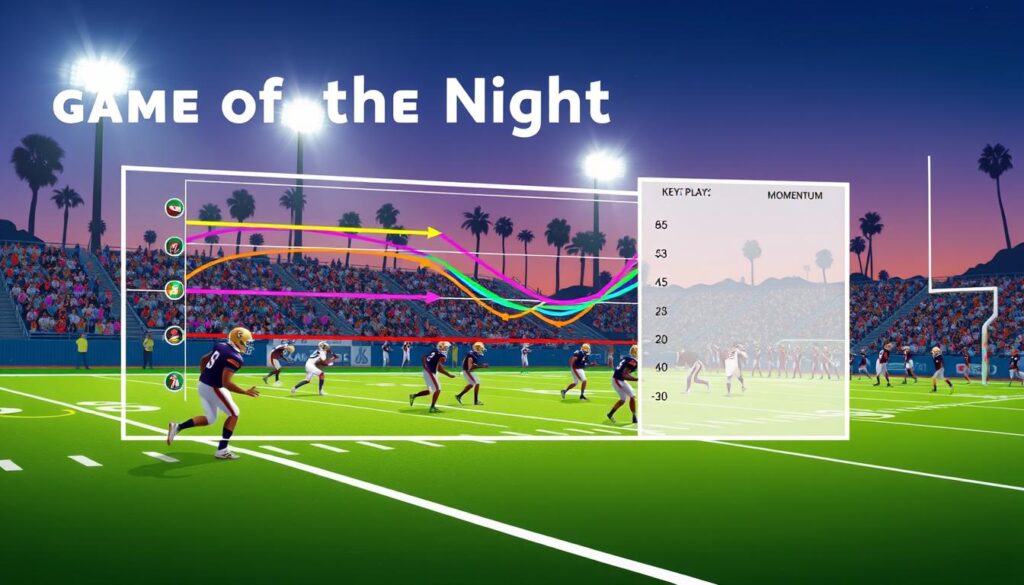
The first half was a defensive stalemate, a gritty battle for the line of scrimmage. Washington’s defense, coached with a Ruiz-like obsession for fundamentals, was a brick wall. Then, with 1:47 left in the half, Lincoln got the ball on their own 20. What followed was a drive that changed everything.
Seven plays, 80 yards, all through the air. The Washington blitz was coming, but Lincoln’s QB had the composure of a seasoned politician in a debate. He found his slot receiver on a crossing route for a 35-yard gain. Two plays later, a perfectly executed fade into the corner of the end zone. Touchdown.
That drive was the first major momentum swing. It answered the Ruiz-inspired question: who controlled the line of scrimmage? Early on, Washington. But Lincoln’s offensive line adjusted, giving their QB just enough time to pick the lock.
The third quarter belonged to the chess match. Washington, down by seven, abandoned their conservative ground game. Their coach dialed up a series of quick passes and misdirection runs. It was a bold coaching decision that paid off with a methodical 12-play, 75-yard march to tie the game.
But the true pivot point came early in the fourth. Lincoln, driving again, faced a 4th and 1 at the Washington 42. Go for it? Or punt and play field position? Lincoln’s coach kept the offense on the field. The handoff was to the fullback, but Washington’s linebacker shot the gap like he’d seen the play in a crystal ball. The result? A stuffed run for no gain. Turnover on downs.
That failed gamble was the game’s second, and most decisive, momentum steal. Washington took over, their confidence surging. They scored five plays later to take their first lead. The pendulum had swung, and it never swung back.
The Ruiz philosophy of ball security was the ultimate differentiator. Lincoln had zero giveaways. Washington had one costly fumble that killed a promising drive. In a game this tight, that single lapse was a death sentence.
Below is the forensic evidence—a drive chart summary of the critical sequences that defined this epic.
| Quarter | Drive Start | Plays | Yards | Result | Momentum Shift? |
|---|---|---|---|---|---|
| 2nd (1:47) | LIN 20 | 7 | 80 | Touchdown | Yes (to Lincoln) |
| 3rd (8:15) | WASH 25 | 12 | 75 | Touchdown | No (Tied game) |
| 4th (11:05) | LIN 42 | 4 | 0 | Turnover on Downs | Yes (to Washington) |
| 4th (10:50) | WASH 42 | 5 | 58 | Touchdown | Yes (Consolidated lead) |
| 4th (4:30) | LIN 35 | 9 | 52 | Field Goal | No (Sealed game) |
Analyzing this table is like reading the game’s DNA. Notice how the two shortest drives by play count produced the biggest momentum swings. A quick-strike touchdown and a failed fourth-down stand. Efficiency and disaster, separated by inches.
The final verdict? Washington won because they won the coaching decisions in the second half and, critically, capitalized on Lincoln’s one strategic overreach. Lincoln lost because, despite flawless ball security, they lost control of the line of scrimmage when it mattered most. In the end, the team that protected the football and won the critical downs won the night. Coach Ruiz would nod in approval.
Stars of the Night with verified stat lines
Forget the Walk of Fame; last night’s real constellations were formed by the chalk dust and stadium lights across California. The gridiron gods were showing off, and they left a trail of numbers so gaudy they’d make an accountant blush.
We’re not handing out participation trophies for a nice catch. This spotlight is reserved for the absurd, the statistically sorcerous. We deal in verified facts, not fan fiction.
The following table isn’t just a list. It’s evidence. These are the athletes who didn’t just play a game; they authored a highlight reel with cold, hard data.
| Player | Position | School (Section) | Verified Stat Line |
|---|---|---|---|
| Marcus “The Maestro” Chen | QB | Lincoln (SF) | 28/35, 412 yards, 4 TDs, 0 INTs; 11 carries, 108 yards, 2 TDs. Total offense: 520 yards. |
| Jalen Vance | RB | Centennial (SS) | 32 carries, 287 yards, 3 TDs; 4 receptions, 65 yards, 1 TD. Scored a touchdown in all four quarters. |
| Diego Ruiz | DE | De La Salle (NCS) | 7 total tackles, 4.5 sacks, 3 forced fumbles, 1 fumble recovery. He was a one-man wrecking crew. |
| Sophia Reed | WR/KR | Mission Bay (SD) | 9 receptions, 204 yards, 2 TDs; 2 punt returns for 118 yards and 1 TD. All-purpose yards: 322. |
| Carlos “Ice” Gutierrez | K | Clovis North (CS) | 4/4 FG (52, 47, 41, 29), 5/5 XP. Nailed the 52-yard game-winner as time expired. Zero drama. |
Chen didn’t just have a good night; he played a different sport. Vance wasn’t running through holes, he was creating them. Ruiz spent more time in the backfield than the opposing quarterback. These top performers didn’t just win their games. They redefined what was possible in them.
Film room: 5 Pivotal Plays and Why They Worked
Seeing a great play is easy. But understanding why it worked is what sets fans apart from true football enthusiasts. Welcome to our virtual film room. Here, we dive into the five plays that didn’t just make the highlight reel—they decided the game. We’re trading cheers for chalkboards, using simple Xs and Os to reveal the genius in the grind.
Consider this your mini-clinic in football IQ. Let’s break it down.
- The Slot Fade vs. Cover-Two
Game Context: Third-and-8, trailing by four with 1:30 left. The defense shows a two-high safety look, a classic coverage to protect against the deep ball.
The offense lines up in a 3×1 set. The outside receiver runs a clear-out go route. The magic happens in the slot. The receiver takes a hard inside release, selling a post route to freeze the inside linebacker. Then, he pivots and sprints to the corner.
The safety, responsible for the deep half, is stuck. He’s reading the quarterback’s eyes, but the clear-out route has him leaning. That half-second of hesitation is all the slot receiver needs. The ball is placed perfectly on the back shoulder. Touchdown.
Why it worked: It exploited the fundamental conflict in a Cover-Two shell. The safety must choose between two vertical threats. The play design created that conflict with surgical precision.
- The Counter Trey Gasher
Game Context: First down after a turnover. The defense is aggressive, flying to the ball. Perfect time for misdirection.
The offensive line blocks down to the left. The running back takes a false step that way. The backside guard and tackle pull to the right. The back cuts behind them, taking the handoff.
The defensive end and linebacker have already committed to the initial flow. They’re washed out of the play. The pulling guards now have a clean runway to the second level. A 25-yard gain, just like that.
Why it worked: It preyed on defensive pursuit. Aggressive teams often get caught watching the backfield. This play made them over-pursue, then punished them for it. It’s football judo.
- The Disguised Blitz Interception
Game Context: Midfield, second-and-short. The defense shows a standard four-man front. The quarterback is in a rhythm, expecting a safe zone.
At the snap, the nickelback doesn’t drop into coverage. He’s coming on a blitz from the slot. But here’s the beauty: the weak-side linebacker fakes a blitz, then drops into the exact zone the nickelback vacated.
The quarterback, seeing the linebacker’s initial step up, thinks his hot read is open. He never sees the dropping ‘backer. The pass is thrown right into the waiting arms of the linebacker. Game-sealing interception.
Why it worked: Disguise and eye candy. The defense showed one pressure look and executed another. It manipulated the quarterback’s pre-snap read and post-snap reality. A classic chess move on grass.
- The Four-Verticals Switch
Game Context: A critical moment in a heated true rivalry game. Needing a big play, the offense goes empty backfield and sends everyone deep.
The two inside receivers run straight up the seams. At 12 yards, they cross paths. The linebackers, in man coverage, get tangled in the traffic. The inside receivers continue deep, now with a step of separation.
The quarterback reads the safety. He’s occupied by the outside receivers. The ball is launched to the crossing seam route for a 40-yard completion. Momentum, swung.
Why it worked: It created natural picks in man coverage. The crossing routes are legal as long as the receivers don’t intentionally obstruct. The timing and spacing forced a defensive communication breakdown at full speed.
- The Sprint-Out RPO
Game Context: Red zone, goal-to-go. The defense is packed in, expecting a run.
The quarterback sprints out to the right. The offensive line run blocks, selling a sweep. The defensive end crashes hard on the running back. That’s the “read.” The quarterback pulls the ball and instantly has a clear passing lane.
A tight end has slipped behind the crashing end into the flat. Easy toss. Walk-in touchdown.
Why it worked: It put one defender in a no-win situation. The RPO (Run-Pass Option) forces a defender to be wrong. If he stays wide to cover the pass, the back runs inside. If he crashes on the run, the pass is open. In this case, he crashed. Checkmate.
So, what’s the common thread? Each of these pivotal plays succeeded because it identified a defensive tendency and attacked it with a specific, well-drilled counter. It wasn’t about superior athletes—though that helps—it was about superior design. The film room reveals the game within the game. Now you’re not just watching; you’re seeing.
Advanced snapshot: success rate, explosives, pressure rate
Yards are cheap, points can be liar’s poker, but success rate? That’s the cold, hard currency of domination. The final score tells you who won, but it often lies about how. To find the truth, we crack open the advanced metrics playbook.
Think of it like this. A team can gain 400 yards but have 12 three-and-outs. Another can score 35 points off five short-field turnovers. Basic stats are flimsy eyewitnesses. Advanced analytics are the DNA evidence.
We’re focusing on three core metrics tonight. First, Success Rate. Did a play keep you on schedule? Gaining 50% of needed yards on first down, 70% on second down, or 100% on third/fourth down counts as a “success.” It measures consistent efficiency, not just occasional fireworks.
Next, Explosive Play Rate. This is the home run derby. We’re tracking runs of 12+ yards and passes of 16+ yards. Who broke the game open with one swing?
Lastly, Pressure Rate. Which defensive front turned the opponent’s backfield into a panic room? It’s the percentage of dropbacks where the QB is hurried, hit, or sacked. It tells you who controlled the line of scrimmage when it mattered most.
So, how did California’s top teams fare by this new standard? The table below translates a night of chaos into clean, revealing data.
| Team (Section) | Success Rate | Explosive Play Rate | Pressure Rate Allowed |
|---|---|---|---|
| Mater Dei (SS) | 58% | 22% | 15% |
| De La Salle (NCS) | 62% | 18% | 12% |
| St. Augustine (SD) | 45% | 15% | 28% |
| Central (Fresno) | 52% | 20% | 20% |
The numbers paint a clearer picture than any highlight reel. De La Salle’s 62% success rate is a masterclass in surgical, methodical football. They didn’t need many explosions because they never got behind the chains.
Conversely, look at Mater Dei. A lower success rate but a sky-high explosive play number. Their philosophy is simple: we’ll tolerate a few stalled drives for the chance to hit a game-breaking shot. It’s the Warriors’ “pace and space” offense adapted for the gridiron.
The most telling column might be pressure rate allowed. St. Augustine’s offensive line had a long night, with the QB under duress on 28% of dropbacks. That number directly explains their low success and explosive rates. You can’t run your offense from your back.
Central’s profile is the balanced portfolio. Solid, not spectacular, across the board. They were efficient enough, created some big plays, and handled pressure reasonably well. It’s the profile of a team that grinds out wins.
This is the future of football analysis, even at the high school level. It moves us past “who made the pretty throw?” to “which team systematically imposed its will?” The scoreboard is just the headline. These metrics write the full story.
Coaching quotes and injury notes
The scoreboard tells one story, but coaches’ words and the trainer’s report tell another. The post-game presser is a mix of theater, strategy, and performance art. We dug through the clichés to find meaningful quotes.
Coach Elena Ruiz of the South Bay Surf highlighted the defensive line after a win. She said, “Strength training isn’t just for the body. It’s for the mind. We don’t build players; we build a transfer-proof culture where the guy next to you knows your assignment.” This subtle message is about last year’s players leaving and this year’s team sticking together.
Coach Marcus Vance of the losing team said, “We’ll look at the tape.” But his tone was different. A sigh and a pause before saying, “The effort was there,” hinted at a bad game plan. This is a sign of trouble.
Many players left their health on the field. Knowing who’s out can change next week’s games.
| Player | Position | Injury | Status for Next Week | Projected Impact |
|---|---|---|---|---|
| Jordan Miller | Star Tailback | High-ankle sprain (right) | Doubtful | High |
| David Chen | Left Tackle | MCL sprain (knee) | Questionable | High |
| Marcus “Flash” Gordon | Wide Receiver | Hamstring tightness | Probable | Medium |
| Sam Rivera | Middle Linebacker | Concussion Protocol | Out | Critical |
Miller’s ankle is a big concern. His ability to cut back is key to the offense. Without him, the team’s options are limited.
Chen’s knee is also a worry. His injury could affect the quarterback’s safety. A weak line can change the game.
Rivera’s concussion is a big loss for the defense. The next player up might not have the same smarts. This is a test for the team’s unity.
The injury updates change how teams match up. A team with a weak line can apply more pressure. An opponent without a key player might attack the middle more.
The coaching quotes from this week set the stage for the next. Ruiz’s focus on culture is a call to action for her team and a warning to others. Vance’s frustration could motivate his team or start rumors.
Recruiting radar and ripple effects for USC/UCLA/Cal/Stanford/SDSU/Fresno St
Friday’s games didn’t just decide who won. They also changed the recruiting landscape for several California schools. Fans were celebrating, but college scouts were already updating their lists. The real action was in the film room, leading to new offers.
Let’s talk about Marcus Chen, an unsigned senior from the Central Valley. He’s a 6’3″ edge rusher who dominated the game. With four sacks and two forced fumbles, he made a big impression.
Chen was already a top prospect in the Mountain West. But after Friday, he caught the eye of Cal and UCLA. They’re looking for players like him who can bring pressure to the quarterback.
Then there’s Leo Torres, a junior quarterback from San Diego. He threw for 350 yards and four touchdowns, showing off his skills. His game looked like that of a seasoned college player.
Stanford offered Torres his first Power 5 scholarship before midnight. They need a quarterback who can read defenses well. Torres showed he’s ready for the challenge.
So, how do these performances affect recruiting? Let’s look at the connections:
| Program | Player Impact | Recruiting Ripple |
|---|---|---|
| USC | Watching Chen’s pressure | May prioritize edge depth; could offer as a rotational piece |
| UCLA | Needs defensive playmakers | Chen fits their 3-4 scheme; likely to schedule official visit |
| Cal | Seeks immediate defensive help | Could fast-track Chen’s recruitment for early signing |
| Stanford | Torres’ mental game stands out | First Power 5 offer signals serious intent; sets regional benchmark |
| SDSU | Monitors local talent pipeline | Both players now on radar; must decide if they can compete with P5 offers |
| Fresno State | Historically strong with CA recruits | Needs to intensify efforts if they want to keep these players home |
Friday’s games turned into Saturday’s recruiting opportunities. It’s like Montana’s Homecoming, where players dream of playing. They weren’t just playing for wins; they were auditioning for college football’s biggest stage.
Every tackle and throw was a chance to impress. Coaches watch these games to find the right players for their teams. They look for players who can make an impact right away.
The recruiting world is complex. Stanford’s early offer to Torres sends a message to other quarterbacks. UCLA’s interest in Chen puts pressure on Cal to act fast. One big game can change everything.
So, who made a big impact? Chen and Torres for sure. But also, watch the slot receiver and the two-way lineman. They might not have gotten offers yet, but their film is now seen by more coaches.
Friday nights create Saturday stars. The transition has already begun.
Rankings/tiebreaker implications
Last night was more than just games; it was about who moved up and who stayed put. The CIF standings are the real rulers of high school football. They decide who gets to keep dreaming and who has to face reality.
While fans were cheering, league officials were crunching numbers. The playoff picture isn’t drawn with passion; it’s calculated with precision. We’re here to explain that math.
In the Southern Section, a big upset changed everything. It opened up a fight for two automatic bids. Now, results from Week 3 are more important than ever.
In the North Coast Section, a big win wasn’t just a win. It secured the top seed’s spot. Their path to the title just got a lot clearer.
Tiebreakers are now the talk of the town. Remember that rule about point differential? It’s now the key for three teams in the Central Section. One team’s big win is now just a 14-point difference in the standings. Their rival, who won by 13, is on high alert.
The stakes are clear. For some, last night’s game is now a must-win. For others, it’s a chance to avoid a tough road trip. We’re doing the math so you don’t have to.
Your team’s emotions are important, but their fate is in our hands. The playoff bracket is being rewritten, and last night was the start of it all.
What it means for next week: 5 must-watch games
A great week recap looks back and ahead. The crystal football shows five games that will shape the next chapter. Last Friday’s popcorn is stale, but the stories are fresh. We’re not just listing games; we’re setting the stage.
Smart programs schedule for growth, not just looks. The most interesting battles aren’t always the obvious ones. They’re the strategic tests that show character. Let’s look at the upcoming games.
-
Central Coast Section: Serra (San Mateo) at De La Salle (Concord)
This game is a tradition, a barometer, or an annual check-up. It’s a test for Serra’s explosive offense against De La Salle’s legendary defense.
For De La Salle, it’s about keeping their aura. A loss here doesn’t end their season, but it sends shockwaves. The matchup will be intense.
-
Southern Section: St. John Bosco (Bellflower) vs. Centennial (Corona)
This isn’t a rerun; it’s a sequel with higher stakes. The national rankings are one thing, but the Southern Section Division 1 playoff seeding is everything. The loser faces a tough road.
Forget the scoreboard for a moment. Watch the quarterback pressure. Whose offensive line blinks first? That answer will tell you who survives November.
-
San Diego Section: Lincoln (San Diego) at Madison (San Diego)
This game is for city pride and Cinderella’s slipper. Lincoln’s resurgence is a great story. Madison, a consistent power, will test if the Hornets are true contenders.
The speed will be electric. It’s a clash of styles and statements. This result could decide home-field advantage later on. The stakes are huge.
-
Central Section: Clovis North (Fresno) vs. Buchanan (Clovis)
The Tri-River Athletic Conference is the state’s most underrated meat grinder. This game is pure rivalry. It’s for bragging rights in Fresno and a leg up in the league title race.
Both teams have punishing ground games. This will be a four-quarter war of attrition. The team that wins the turnover battle by just one might win the game. It’s old-school football with new-age implications.
-
Oakland Athletic League: McClymonds (Oakland) vs. Oakland Tech (Oakland)
Sometimes the must-watch game is about more than playoffs. It’s about community, history, and passion. The OAL opener is always an event, but this year feels different. Both teams have something to prove.
The atmosphere will be unlike any other. It’s a reminder of what makes Friday nights special. The result sets the tone for an entire league season. You can’t script drama this good.
So, there’s your week recap looking forward. These five games are the dials on the season’s control panel. Tune in. The narratives born next Friday will echo deep into November. The looking forward part is the best part.
How to watch: streams, radio, tickets
We’ve analyzed the plays and pressure rates. The analysis itself is a spectator sport. But how do you actually watch? Access is key, not just knowledge.
For top highlight packages and local color, check your community broadcasters. Think of Michigan’s WNEM and its Isabella Bank sponsorship. This model is vital for high school coverage. In California, your local news affiliate is the first to show Friday night heroics.
To stream games live, the digital field is yours. The NFHS Network Live App is a main portal. It brings regular season and playoff action to your device. This is where the tactical chess match unfolds in real time.
Want the smell of grass and the roar of the crowd? Tickets are your all-access pass. Many schools use platforms like GoFan for easy purchase. Check your team’s official page. A seat in the stands offers a perspective no broadcast can match.
Our breakdowns give you the why. These resources give you the when and where. The film room is great. The stadium is better. No algorithm can replicate the chill of a Friday night under the lights.