Watching UCLA basketball in the Big Ten is like seeing a surf legend in a snowboarding contest. It’s a big change.
The atmosphere is different. The place is new. The basketball style is tough.
The Bruins’ first year is a fascinating case study in cultural adaptation. Are they fitting in or facing trouble?
This isn’t just about winning games. It’s about identity. UCLA’s tough, defensive style is being stress-tested weekly in the Midwest.
We’ll explore their position. How did they get here? And will this experiment lead to the Big Dance or a long offseason?
Defensive metrics and tempo trends
Mick Cronin faces a challenge in his new conference. His defensive identity—built on protecting the paint and contesting shots at the rim—thrived in the Pac-12’s tempo and spacing. But in the Big Ten Conference, where physical post play and half-court execution dominate, that formula will be stress-tested. Adjusting to this shift requires the same structural discipline and cultural buy-in seen in enduring programs shaped by Crimson Tide sports traditions, where adaptability and identity evolve together without losing their core.
UCLA gives up three-point attempts on 47.0% of opponents’ shots. This is the 16th worst in the league. The Bruins also take the fewest threes in the Big Ten. This is a big change from their old style.
This change is more than just a small tweak. It’s a big mismatch. Teams like Nebraska, which loves to shoot from deep, will find UCLA’s defense too easy to exploit. It’s like inviting them to shoot more.
The tempo of the Big Ten is also a big change. It’s a slow, physical league. UCLA’s defense, built for fast games, might struggle here. Can they adjust to this new pace?
The table below shows how UCLA’s defense is different from the Big Ten. It highlights the big gap between UCLA and other teams.
| Team | Opponent 3PA% (Big Ten Rank) | Opponent 3P% | Defensive Philosophy Note |
|---|---|---|---|
| UCLA | 47.0% (16th) | ~34% | Paint-first, allows perimeter looks |
| Nebraska | ~45% (High) | ~33% | Aggressively forces long-range shots |
| Purdue | ~32% (Low) | ~31% | Balanced, protects both areas |
| Illinois | ~38% (Mid) | ~32% | Length disrupts all levels |
| Big Ten Average | ~40% | ~33% | Modern, pace-and-space influenced |
The question for Mick Cronin is not about effort or toughness. It’s about adapting. Can protecting the rim work when the game favors three-pointers? UCLA’s biggest flaw is its defense. Watching if Cronin changes his strategy will be interesting.
Rotation watch: freshmen development and veteran roles
Forget the starting five for a second. The true pulse of this UCLA season is in the minutes given to freshmen and the veteran’s heavy breaths. This is the core of the latest UCLA basketball news: a rotation in flux, where talent meets punishment nightly.
The development arc for newcomers isn’t easy. It’s like scaling a cliff in a blizzard of elbows and box-outs. The question isn’t just about talent. It’s about how quickly a player can go from wide-eyed to wide-bodied. Are they just surviving, or starting to thrive in the muck?
On the other hand, veterans carry a different weight. They remember a different league. Their load isn’t just physical; it’s mental, serving as on-court coaches while battling their own fatigue. In the Big Ten, your bench isn’t a luxury. It’s a necessity for survival. The eighth or ninth man isn’t a afterthought—he’s a season-saver when foul trouble hits at the 12-minute mark in East Lansing.
Mick Cronin’s rotation decisions now are pure triage. He’s managing the enthusiasm of youth against the weariness of experience. Who emerges as the reliable sixth man could define February. It’s a daily calculus:
- Freshmen Minutes: How much rope do you give a talented rookie before a mistake costs a game?
- Veteran Load: Can your core guys log 35 minutes in January and have legs in March?
- Matchup Roulette: Does the opponent’s style demand a defensive specialist or an offensive spark off the bench?
This is where seasons are built, not in highlight reels, but in the gritty details of practice reps and minute allocation. Tracking this rotation evolution is essential UCLA basketball news. The answers will tell us if this is a team merely competing, or one constructing a resilient identity for March.
Signature wins/losses and NET/KenPom snapshot
The NCAA’s NET ranking tells a story of UCLA’s near misses. They are ranked 39, stuck between “lock” and “long shot.” Their record is solid, but in Los Angeles college basketball, that’s not enough for a secure spot on Selection Sunday.
The Quadrant system is how the NCAA sorts teams. It’s a quick way to see who’s in and who’s out.
| Quadrant | Record | The Story |
|---|---|---|
| Quad 1 | 3-8 | The tell-tale heart. It screams missed opportunities against the elite. |
| Quad 2 | 6-2 | Strong. Shows they handle business against good, not great, teams. |
| Quad 3 & 4 | 10-0 | Pristine. The hallmark of a well-coached team that avoids catastrophic losses. |

UCLA’s record shows they’re good, but not great. Their 3-8 mark in Quad 1 is a big issue. It could mean they miss out on a comfortable seed.
They’ve shown up for big games, but haven’t won the big ones. This is their biggest weakness. Their Strength of Schedule is ranked 59th, which isn’t enough to get them into the tournament alone.
UCLA has built a solid foundation. They are disciplined and don’t lose to weaker teams. But they haven’t shown they can win the big games. They have all the tools, but need that one big win.
The question is about timing. Can they get that big win in the Big Ten schedule? Until then, the NET will keep telling the same story.
Travel grind: East/Midwest trips and rest management
The toughest opponent in Big Ten hoops isn’t on the court. It’s the long flights across the country. UCLA faces a foe that’s undefeated: the Central Time Zone.
Nebraska enjoyed a break in Southern California after winning. UCLA, on the other hand, had to fly back after losing at Minnesota. This shows a big disadvantage for UCLA in the new league.
Traveling to the East and Midwest is tough. It’s not just the distance. It’s the early tip-offs and trying to sleep on planes.
Mick Cronin must find ways to help his team. He needs to manage practice and rest. It’s not just about physical strength, but also mental.
| Road Trip Destination | Time Zone Shift | Opponent Rest Advantage | Tip-Off (Local vs. PT) |
|---|---|---|---|
| At Minnesota | +2 hours (CT) | Moderate (Home stand) | 8:00 PM CT / 6:00 PM PT |
| Hosting Nebraska | 0 hours (PT) | Severe (Opponent in-region) | 7:00 PM PT / 7:00 PM PT |
| At Michigan (Projected) | +3 hours (ET) | High (Following opponent travel) | 12:00 PM ET / 9:00 AM PT |
| At Purdue (Projected) | +3 hours (ET) | Severe (Trap game sequence) | 2:00 PM ET / 11:00 AM PT |
This table shows the tough travel schedule in Big Ten hoops. The “Rest Advantage” column shows UCLA’s big challenge before the game starts.
Cronin might use strict sleep rules and light practices on travel days. But, you can’t avoid the effects of long flights. This travel is a big part of UCLA’s move to the Big Ten, affecting player health and performance.
Even if UCLA loses, the real battle might have been on a plane. Welcome to the Big Ten hoops road show.
Scouting the next opponents—matchups to monitor
Nebraska is next, built to test UCLA’s biggest fears. This game is more than just a match; it’s a test. For the latest UCLA basketball news, this game is the main event.
The Cornhuskers are ranked NET 12 for a reason. They’re expected to be a 3-seed. Their defense is perfect for teams that don’t like uncertainty. They push UCLA to play a game they dislike: a focus on the three-point shot.
Nebraska’s offense is all about the three-pointer. Players like Sandfort, Lawrence, and Mast are ready to shoot from anywhere. Can UCLA’s guards handle the pressure? Can they stop Nebraska’s offense without fouling? These are the big questions.
Looking ahead, every game is a new challenge. The bracketology table is our guide. Each game is a test of UCLA’s skills.
This isn’t just about the game plan. It’s about understanding the teams’ minds. Which team’s style will hurt UCLA the most? Is it a team that likes to slow down the game or one that loves fast breaks? Scouting in the Big Ten is all about avoiding surprises.
The final matchups will show UCLA’s true strength. Are they contenders or just pretenders? The answer will come from solving these defensive puzzles. Watching these games closely is the only way to find out.
Bracketology implications for March
For UCLA and Mick Cronin, March is a fight for a spot in the tournament. Bracketology shows they’re fighting to stay in. Welcome to Bubble Watch, a sports reality show that’s all about getting in.
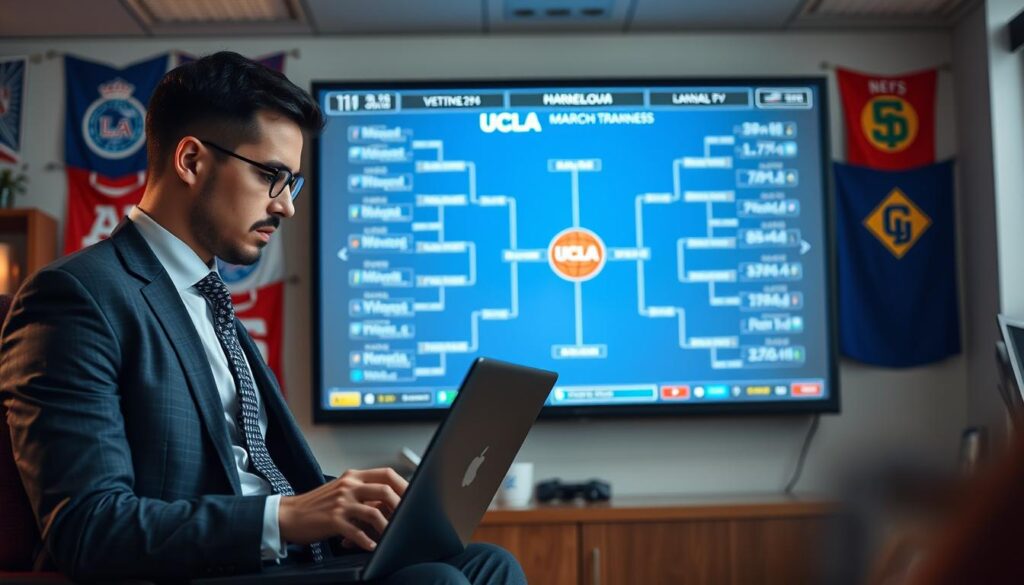
What’s the latest? UCLA is a “W” seed, but they’re on the bubble. The field behind them is crowded.
Here’s the situation:
- The Big Ten and SEC are fighting for top conference status. They might send up to 11 teams to the tournament.
- UCLA’s rivals, USC and Ohio State, are right behind them. They’re listed as “First Four Out.” UCLA’s losses could mean their rivals get in.
Every game is now a test of the season. A win is a must, not just a bonus. A loss is a nightmare for fans.
Mick Cronin now focuses on survival, not just winning. His team is all about getting results, not just playing well. The margin for error is zero.
Can UCLA make it if they lose to a Big Ten team? With 11 bids possible, the answer might be no. UCLA is fighting against a crowded field. For Mick Cronin and his team, the only way off the bubble is to win.
How to watch/stream in California and ticket notes
Here’s your essential guide to catching the Bruins’ late-night drama. You can watch from your couch or the heart of Pauley.
The broadcast home for this clash is FS1. The tip-off is 11:59 p.m. ET, or 8:59 p.m. Pacific Time. This is a rare win against the East Coast time zone overlords. You can watch the full game and have a semblance of an evening.
If you’re streaming, you’ll need a service that carries Fox Sports 1. Think YouTube TV, Hulu + Live TV, or Sling Blue. It’s the must-have channel for anyone following Los Angeles college basketball in its bold Big Ten experiment.
For the live experience, head to Pauley Pavilion, Los Angeles, CA. The vibe inside this season is fascinating. The desperation of a Final Four run is gone, replaced by the tension of proving themselves in a new league.
Tickets are different now. Getting in is less of a battle than in years past. But the stakes in the air are just as high. You’re not buying a seat for a coronation; you’re buying a front-row spot to a compelling, high-stakes crossroads.
It’s the perfect time to witness this evolution firsthand. The cheers echo differently when every game feels like a statement. For deeper context on the unique travel grind of this new conference, the challenges extend far beyond the court. Following this chapter of Los Angeles college basketball requires a new kind of fan playbook. Consider this your first page.
What success looks like over the next month
Forget the highlight reels; success for UCLA in the final stretch of Big Ten hoops is a spreadsheet exercise. It’s about the ruthless arithmetic of résumé building, not the poetry of a fairy tale. Over the next month, defining a win isn’t about style points—it’s about checking pragmatic boxes that silence the bubble talk on Selection Sunday.
- Handle Your Business: The schedule presents a few must-win games. Success looks like going 3-1, or even 4-0, in those manageable contests. No catastrophic, season-crumbling losses to teams they should handle. This is non-negotiable.
- Steal One More Marquee Win: The Bruins need at least one additional Quad 1 victory. It’s that critical line on the NCAA tournament résumé that separates comfort from chaos. It proves they can beat tournament-caliber teams in this league, not just survive it.
- Enter the Conference Tourney in Peace: The goal is to arrive at the Big Ten Tournament safely in the field, not sweating on the bubble. Maybe they’re even playing for a slightly better seed. The pressure should be about advancement, not invitation.
- Build Momentum, Not Anxiety: This final stretch is about proving the adaptation to this brutal conference is complete. It’s about building a rhythm and a confidence that travels to a neutral court in March.
Think of it this way: success isn’t a stunning conference title run. That’s the dream. The reality, the successful reality, is a steady, professional march into the postseason. It’s about leaving no doubt that they belong in the national conversation, not pleading their case.
This is the grind of late-season Big Ten hoops. The poetry can wait for March. Right now, it’s all about the math.
Fan pulse and questions to track
In Bruins Nation, the atmosphere is tense. UCLA basketball fans watch social media closely. It shows their mood, swinging from hope to worry with each game.
Coach Mick Cronin is at the heart of the drama. Can his tough style work in the Big Ten’s fast-paced game? Who will step up as the top scorer when it matters most? These are the big questions in Los Angeles college basketball.
Watching the Mick Cronin story is like solving a mystery. We’re all trying to figure it out together. The next few weeks will tell us a lot about UCLA’s future in college basketball. Stay tuned for more surprises.