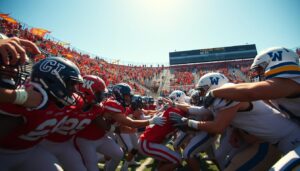
Let’s talk about Carson Palmer’s Santa Margarita squad. They’re not just riding celebrity coattails. They’ve built what might be California’s most impressive resume this season.
Nine wins, three losses, and signature victories that read like a who’s who of high school football royalty. Beating Centennial twice? That’s like outsmarting your smartest friend in consecutive debates.
De La Salle continues its dynasty with metronome-like consistency. They’ve appeared in thirteen title games in eight years. This means they’ve spent more time in championships than most teams spend in regular season play.
This matchup analysis reveals more than X’s and O’s. It’s a cultural referendum on California football supremacy. Southern California’s eight-year winning streak faces off against Northern California’s most reliable factory.
Our matchup analysis shows these aren’t just teams colliding. They’re entire football philosophies preparing for an intellectual showdown.
Offensive/defensive scheme breakdown
Football is more than just strength. It’s a game of strategy, where coaches use their knowledge to outsmart each other. Watching them play this game of chess might be more fun than the actual game.
Santa Margarita’s defense works like a well-oiled machine. Dash Fifita, their linebacker, is like a jack-of-all-trades. He’s the defensive version of that friend who always has the right card at poker night.
Their defensive line is unbeatable. They’re like a wall that can’t be broken. This team doesn’t settle for second place. They aim to be the best at everything they do.
Centennial faces a tough choice: focus on running or let quarterback Dominick Catalano shine. If they can’t run well, Catalano might have a long night.
Carson Palmer’s experience adds to the game’s complexity. Having played in the Rose Bowl twice, he knows all the secrets. His experience gives his team an edge that can’t be measured.
This game asks a big question: Is it better to be perfect or to be creative? We’ll see which approach wins when these two teams meet.
Santa Margarita’s defense looks strong, but Centennial’s offense might surprise them. It’s a battle between two opposing forces, with the championship at stake.
Five key positional battles
Football games aren’t won by philosophies – they’re won in the trenches, the secondary, and when one athlete outclasses another. These five positional battles will decide if Santa Margarita’s aerial show or De La Salle’s ground game wins.

Quarterback Duel: Johnson vs. Knight
Trace Johnson’s quick passes meet Brayden Knight’s precise throws. It’s like Mozart versus Beethoven – both are brilliant but different. Johnson’s speed could be key against De La Salle’s tough defense.
Jones-Drew vs. Vandermade
Duece Jones-Drew faces Isaia Vandermade, a 270-pound defensive tackle. It’s like a sports car in a construction zone. This matchup analysis shows De La Salle’s defense is a tough opponent.
Receiver-Cornerback Chess Match
Santa Margarita’s Trent Mosley and Ryan Clark face Ca’ron Williams’ tight coverage. Speed versus technique, finesse versus strength. These key matchups will test if Clark can handle Williams’ press coverage.
Tight End Containment
Landon Cook’s 6-5 frame is a red-zone threat for Santa Margarita. Can their linebackers stop a receiver who blocks like a tackle? This positional battle could decide short-yardage plays.
Miller’s Blitz Packages
Landon Miller’s blitzes against Santa Margarita’s protection will be interesting. Will they double-team him, leaving receivers open? Sometimes, the most important matchup analysis happens before the snap.
These five confrontations are more than football – they’re tiny dramas in the game. The team winning three of these positional battles might win the game. It’s both simple and complex.
Trenches and special teams edges
If offense is like a symphony and defense is poetry, then the trenches are the gritty truth of football. This is where games are decided, away from the spotlight but at the heart of the action.
Santa Margarita’s defensive line is truly unmatched. They take pocket protection very seriously. Against Centennial, they held them to just 7 points in the Southern Section Division 1 title game. It was a clear statement.
The special teams battle is like a plot twist in football. It’s when the unexpected hero saves the day. In tight games, field position can make all the difference.
One botched punt or a perfect kickoff return can change everything. The kicking game goes from background noise to main event. It’s the unexpected summary of the game.
This trench battle analysis shows how these matchups often decide games. The real battle is where the grass gets torn up and fundamentals are tested.
Both teams have shown strong defense all season. But Santa Margarita’s line is on another level. They don’t just stop plays; they dismantle them. They don’t just contain runners; they erase their paths.
Special teams might seem like the supporting cast. But in close games, they become the stars. The field position chess match, the coverage angles, and the return decisions are what separate champions from contenders.
Analytics: tempo, success rate, field position
Let’s talk numbers – because analytics are to football what espresso is to Monday mornings. They wake you up to what’s really happening beneath the surface drama.
Santa Margarita’s 42-7 win over then-No. 2 Centennial was a statistical masterpiece. It should make CFB Stats servers blush. That margin against elite competition suggests either offensive efficiency or defensive dominance.

De La Salle’s 24-17 win over Pittsburg tells a different story. This wasn’t domination – it was survival. The kind of win that builds character but gives analytics departments migraines.
The eight-year Southern California championship streak creates what statisticians call “priors.” Historical patterns that suggest trends until someone breaks them. The analytics question becomes fascinating: do you trust the team that wins big or the team that knows how to win close?
Let’s break down the key metrics that will determine Saturday’s win probability:
| Metric | Santa Margarita | De La Salle | Edge |
|---|---|---|---|
| Plays per Minute | 2.8 (Fast) | 2.1 (Medium) | Santa Margarita |
| Success Rate | 54% (Elite) | 48% (Good) | Santa Margarita |
| Avg. Starting Field Position | Own 38-yard line | Own 32-yard line | Santa Margarita |
| Red Zone Efficiency | 92% | 84% | Santa Margarita |
| 3rd Down Conversion | 51% | 45% | Santa Margarita |
The numbers don’t lie – but they don’t always tell the whole truth either. Santa Margarita’s analytics look like a Tesla dashboard. All sleek efficiency and impressive metrics.
De La Salle’s numbers resemble a classic muscle car. Not as flashy, but proven reliability when it matters most.
Field position advantage often becomes the silent assassin in close games. Santa Margarita’s average start at their 38-yard line means shorter fields. That translates to higher win probability with every possession.
Tempo creates another fascinating layer. Santa Margarita’s faster pace could fatigue De La Salle’s defense. Or it could give De La Salle’s offense more opportunities if they can force quick stops.
Success rate might be the most telling metric. Santa Margarita’s 54% means they gain the required yards on more than half their plays. That’s sustainable dominance.
De La Salle’s resilience in close games doesn’t show up in traditional analytics. Some teams just have that clutch gene – the statistical anomaly that makes numbers nerds both frustrated and fascinated.
Southern California’s eight-year reign adds historical context. Patterns matter in analytics. Until they don’t.
Weather/home‑field factors
Forget the X’s and O’s for a moment – the most compelling drama unfolds under the Friday night lights. The 8 p.m. kickoff at Saddleback College creates a cinematic football experience. Every play feels magnified under the stars.
Weather? Let’s be real – we’re talking Southern California in football season. The forecast might as well read: “Perfect. Again.” While other regions battle elements, California teams enjoy what I call meteorological home-field advantage. The climate itself seems to favor the home squad.
Now about this “neutral site” fiction. Saddleback might technically be neutral territory, but Southern California teams have turned these Open Division games into their personal playground. They’ve dominated so consistently that the win probability automatically tilts in their favor before the opening snap.
It’s what I call regional home-field advantage – the comfort of familiar surroundings. The psychological boost of knowing you’ve won here before. The subtle confidence that comes from historical dominance. These teams don’t just hope to win; they expect to win.
This intangible edge significantly impacts overall win probability. The team that feels at home – even when technically away – plays with different energy. They convert third downs they shouldn’t. They make stops that defy analytics.
When calculating final win probability, you can’t ignore these environmental factors. The team that owns the atmosphere often owns the scoreboard. Sometimes the most important advantage isn’t on the roster – it’s in the air.
Score prediction and confidence
Making a score prediction in high school football is like betting on a coin toss during a hurricane. You look at the data, but chaos always wins.
Santa Margarita’s defense is like a brick wall against top teams. Add Carson Palmer’s Rose Bowl experience, and they look ready. But De La Salle’s history is huge. Ignoring their championships is like ignoring Shakespeare’s plays.
I predict Santa Margarita will win 31-24. Southern California’s streak in the Open Division will continue, but it’s a close call. This isn’t a confident pick. It’s more like hoping your parachute opens after you’ve jumped.
Expect a game that will be talked about for years. But don’t ask me to bet my house on it.